

A supplier wants a deposit in July for products your customers will not buy until December. That five-month stretch is where many seasonal businesses run short of cash, even in strong years. Dimension Funding, a business lender founded in 1978 with an A+ BBB rating, provides working capital that lets owners place full-size orders without emptying the operating account.
Dimension Funding offers financing up to $10M+. Its fully electronic DocuSign process means approved funding often arrives the same day or the next business day, which matters when a supplier’s production slot is on the line. Owners planning a large stock purchase can start by reviewing working capital loan options built for short-term needs like this one.
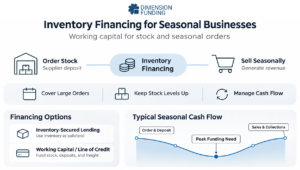
How Much Cash Sits on Your Shelves
Inventory ties up cash longer than most owners estimate. Census Bureau data published in the Federal Reserve Bank of St. Louis FRED database shows that merchant wholesalers held inventory equal to about 1.19 months of sales in April 2026, a ratio that indicates how many months of stock are on hand relative to monthly sales. Seasonal sellers run far above that average in the weeks before their peak.
The cash conversion cycle measures the full wait. It adds the days inventory sits before sale to the days needed to collect from customers, then subtracts the days suppliers give you to pay. A business that holds stock for 75 days, collects in 30, and pays suppliers in 30 has 75 days of cash in limbo on every order.
What Inventory Financing Covers
The term describes two different structures. Knowing which one a lender offers prevents surprises about collateral, reporting, and which goods qualify.
Inventory-Secured Lending
Traditional inventory lending uses the goods themselves as collateral. Lenders typically advance only a portion of inventory value under a borrowing base, require periodic stock reports, and may exclude slow-moving or custom items. This structure can support large balances but adds ongoing monitoring work.
Working Capital Used for Stock
A working capital business loan or a business line of credit is generally evaluated on the business’s overall credit and cash flow rather than an itemized count of goods. Proceeds can go toward supplier deposits, freight, and duties without tracking each pallet. Dimension Funding’s working capital products can be used this way.
Calculate the Peak Inventory Funding Gap by Date
The total cost of a seasonal order is not necessarily the amount you need to borrow. The real requirement depends on when payments leave your account, when customer revenue arrives, and how much cash must stay available for everyday operations. A SCORE mentor’s guide to cash flow in seasonal businesses notes that a cash flow projection reveals when a business may hit a cash-poor position, and it recommends applying for a line of credit while cash is plentiful.
Map Every Payment Milestone
Build a dated forecast running from the first supplier deposit through final customer collection. Record supplier installments, freight, duties, storage, payroll, and other core operating expenses. Then add expected receipts, including customer deposits and sales proceeds, using realistic collection dates rather than invoice dates.
Milestone | Example Timing | Cash Out | Cash In |
Purchase order and 30% deposit | July 15 | $36,000 | None |
Balance due before shipment | September 1 | $84,000 | None |
Freight, duties, and receiving | October 10 | $31,500 | None |
Holiday selling season | Nov. 1 to Dec. 31 | None | Sales begin |
Card settlements and wholesale invoices | December to January | None | Bulk of revenue |
Find the Lowest Projected Balance
Suppose a retailer has $100,000 in cash but must preserve a $40,000 operating reserve, leaving $60,000 available for the order.
Date | Cash Movement | Balance Above Reserve |
July 1 | Available cash after $40,000 reserve | $60,000 |
July 15 | Supplier deposit: −$36,000 | $24,000 |
September 1 | Balance payment: −$84,000 | −$60,000 |
October 10 | Freight, duties, receiving: −$31,500 | −$91,500 |
The projected low point is −$91,500, so the business needs at least $91,500 in financing to complete the order without touching its reserve. That figure assumes no other cash movements. Payroll and rent between July and October would push the low point deeper, so include them in your own forecast.
Stress-Test Late Collections
Repeat the forecast with customer receipts delayed by 15 and 30 days. In inventory businesses, a late January wholesale payment can collide with deposits for spring orders, keeping a balance outstanding longer than planned. If a delayed scenario breaks your plan, consider a larger credit limit or a longer repayment structure rather than a smaller order.
Landed Cost, Not Invoice Price, Sets the Request
Tariffs have widened the gap between what a supplier invoices and what goods cost to put on a shelf. In the Federal Reserve’s 2026 Report on Employer Firms, 48% of small employer firms sourced at least some inputs from outside the U.S. in 2024, and 84% of those firms saw foreign input prices rise in 2025. Tariff-related costs were a financial challenge for 69% of retail firms and 62% of manufacturers.
Cost Component | Amount |
Supplier invoice | $120,000 |
Ocean freight and drayage | $9,000 |
Duties and tariffs (example) | $18,000 |
Customs brokerage and bond | $1,500 |
Cargo insurance | $600 |
Receiving and inbound warehousing | $2,400 |
Total landed cost | $151,500 |
In this example, landed cost runs about 26% above the supplier invoice. An owner who requests only the purchase order amount would come up $31,500 short in October, just as freight and customs bills arrive. Demand is also rising. The National Retail Federation projects November and December retail sales to grow 4.2% over 2025, so suppliers book production slots early.
Matching Repayment to Sell-Through
Repayment should come from the inventory it funded. Before borrowing, estimate how many weeks each product line takes to sell at full price, and finance only the stock you expect to move within the season. Goods likely to sit into spring belong in a smaller second order.
As holiday revenue settles, apply it to the outstanding balance before restocking for the next quarter. Owners who reborrow right away often find January revenue already committed to spring orders, leaving no cushion if returns run high.
Why Owners Use Dimension Funding for Stock Purchases
Dimension Funding has provided business financing for more than 40 years. It generally prefers two or more years in business, though strong credit can offset a shorter history. Electronic documents shorten the time between approval and funding when a supplier deadline is fixed. More background is on the About Us page.
Bring your dated cash forecast, purchase orders with supplier terms, a landed cost estimate, prior-season sales by month, and recent bank statements. Together they show the lender when cash leaves, when it returns, and how last season performed. Requests can start through the online financing application.
Stocking Up for the Season Without Draining the Operating Account
Strong seasons are won months in advance by businesses that can place full orders on the supplier’s timeline. Inventory financing sized to your lowest projected balance and repaid from sell-through lets you do that while keeping your operating reserve intact.
If a supplier deposit or production deadline is approaching, Contact Dimension Funding to discuss the right structure for your order. You can also call 1-800-755-0585 or email Sales@DimensionFunding.com.
Frequently Asked Questions
Can I finance goods while they are still in transit?
Working capital is not tied to the goods themselves, so in-transit timing generally does not affect eligibility. Check the shipping terms on your purchase order. Under FOB terms, risk generally transfers to the buyer once goods are loaded aboard the vessel at the origin port, so arrange cargo insurance from that point.
Should I order everything at once to get a volume discount?
Not automatically. Compare the discount against the cost of carrying unsold stock, including storage, markdowns, and financing costs. If the discount is small, splitting the order into two waves can lower your peak balance and reduce the risk of excess inventory after the season.
Does buying inventory with financing lower this year’s taxes?
Usually not right away. Inventory is generally deducted as cost of goods sold when items sell, not when you buy them. A large fourth-quarter purchase that sells in January may not reduce current-year taxable income. Some smaller businesses qualify for simplified inventory methods, so confirm your treatment with a CPA.
What happens if the season underperforms?
Repayment does not depend on how much stock sells, so plan for a weaker season before ordering. Negotiate return or exchange rights with suppliers for unsold units where possible. Also decide in advance which product lines you would mark down first if sales lag.
Can manufacturers use inventory financing for raw materials?
Yes. Working capital can fund raw materials and components as well as finished goods. Manufacturers should add production time to the cash conversion cycle, because materials purchased today may not become sellable products for several weeks.
How early should I apply?
Apply when the purchase order is drafted rather than in the week the deposit is due. Dimension Funding can move quickly once a request is approved. Gathering documents early, however, leaves room to answer questions without putting your production slot at risk.
Can I finance new equipment needed to handle a larger season?
Yes, and keeping it separate preserves working capital for stock. Dimension Funding offers equipment financing, and equipment loans up to $250,000 require no financial statements. Shelving, forklifts, or packaging machinery can be financed over a longer term than seasonal inventory.