

A business line of credit is flexible enough to fund almost anything a business needs, which is exactly why it gets misused. Dimension Funding structures its working capital lines around short-term, recurring needs, and knowing which situations actually fit that structure — and which ones don’t — determines whether a line of credit ends up being the right tool or an expensive workaround. The list below draws a clear line between the two.
Usage data backs up how common this tool has become for exactly the kind of short-term needs it’s built for. Roughly a third of employer firms used a line of credit on a regular basis in a recent survey year, alongside credit cards and term loans, reflecting how many businesses keep one on hand specifically for timing gaps rather than large one-time purchases.
Six Cash-Flow Timing Gaps a Line of Credit Should Cover
These are the classic use cases: short, predictable, and tied to a specific gap between when money goes out and when it comes back in.
Seasonal inventory buildup. Stocking up ahead of a predictable busy season is one of the clearest matches for a revolving line, since the draw gets repaid once the season’s sales come in. The SBA structures its own Seasonal CAPLine program around this exact use case, financing seasonal increases in inventory, receivables, and sometimes labor — the same logic applies whether the line comes through an SBA-backed program or a private lender.
Payroll during a slow revenue week. A short dip in incoming cash shouldn’t put payroll at risk, and a line of credit is built for exactly this kind of brief, recoverable gap.
Bridging the wait on a large invoice. When a client pays on 60- or 90-day terms, a line of credit can cover the gap between delivering the work and getting paid for it.
Unexpected equipment repairs. A broken piece of equipment that needs fixing now, not next quarter, is a short-term expense that a line of credit can absorb without disrupting a longer-term financing plan.
Time-limited vendor discounts. Buying in bulk to capture a discount that expires in a week is a short-term opportunity cost, not a long-term investment, and fits the same draw-and-repay pattern.
Managing the timing gap between payables and receivables. Businesses that pay suppliers faster than customers pay them often use a line of credit specifically to smooth that mismatch.
Three More Everyday Uses Worth Covering
Beyond the most obvious timing gaps, a line of credit also fits situations that are short-term in nature even if they don’t repeat every month.
A short-term cost increase from a supplier. If a key input temporarily costs more due to a supply disruption, a line of credit can absorb that spike without forcing a price change or a delay in fulfilling orders.
A marketing push with a known, quick payback. A short campaign tied to a specific, time-bound promotion can be funded on a line of credit if the expected return arrives within the repayment window.
A cash reserve for the genuinely unpredictable. Some businesses draw on a line specifically to build a short-term buffer against an emergency, then repay it once the immediate need has passed, using it as a safety net rather than a spending source.
Three Uses a Line of Credit Should Avoid
A revolving line isn’t the wrong product because it’s flexible — it’s the wrong product when the underlying need isn’t actually short-term.
Long-term equipment or real estate purchases. An asset with a useful life of five or ten years is a mismatch for a facility built around draw-and-repay cycles measured in weeks or months; a term structure with amortization matched to the asset’s life is the better fit. Dimension Funding’s equipment and software financing options exist specifically for this kind of longer-term purchase.
Covering chronic, ongoing operating losses. If a business is regularly drawing on its line just to stay current on expenses month after month without repaying the balance down, that’s a signal the underlying business model needs attention, not that the credit facility needs to be larger.
A single large strategic investment better suited to a term loan. A major expansion, acquisition, or buildout with a defined cost and a multi-year payback horizon is generally better matched to a fixed-schedule loan than to a revolving line, since the repayment structure and total cost planning work more predictably that way.
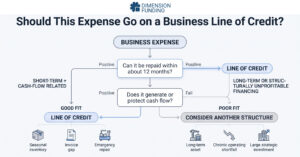
Should This Expense Go on a Business Line of Credit?
Every example above traces back to the same two-question test: can the expense reasonably be repaid within about 12 months, and does it directly generate or protect cash flow? Seasonal inventory, an invoice bridge, or an emergency repair pass both tests, which is why they show up on the “should” list. A warehouse addition or machinery with a decade-long useful life fails the first question outright, since the repayment timeline doesn’t match a revolving structure no matter how the expense is framed.
This split mirrors how the Small Business Administration itself organizes its financing options — programs like 7(a) and 504 loans are built for longer-term financing, while CAPLine-style revolving structures exist specifically for short-term, cyclical working capital needs. The same logic applies to any working capital line: it’s designed to solve a temporary timing gap, not to substitute for financing that should carry a longer repayment schedule.
Test Question | If Yes | If No |
Can the expense be repaid within about 12 months? | Continue to the next question | Consider a term loan or equipment financing |
Does the expense generate or protect cash flow? | Good candidate for a line of credit | Evaluate alternative financing options |
Matching the Need to the Right Structure
Type of Need | Line of Credit Fit | Better Alternative |
Seasonal or recurring cash gap | Strong fit | — |
Emergency repair or short opportunity | Strong fit | — |
Long-term asset purchase | Poor fit | Term loan or equipment financing |
Chronic operating shortfall | Poor fit | Business restructuring, not more credit |
Large one-time strategic investment | Poor fit | Term loan with fixed amortization |
Structural fit like this matters because recent Federal Reserve survey data show small employer firms have been reporting challenges growing sales alongside increased costs, and stretching a revolving line to cover problems it wasn’t designed for tends to compound that pressure rather than relieve it. A line of credit works best as one part of a broader financing plan rather than the only tool in it.
Get the Right Structure for Each Need
Knowing which nine situations fit a line of credit — and which three don’t — is the difference between using credit as a flexible cash flow tool and using it as a substitute for a financing plan that’s actually missing. Dimension Funding’s working capital lines are built for the short-term, recurring side of that list, while equipment and software financing options cover the longer-term purchases a line of credit was never meant to carry. Contact Dimension Funding to talk through which category your next financing need falls into.
FAQs
Can a line of credit be used to cover a one-time large purchase if it’s repaid quickly?
It can, but the fit depends on how quickly “quickly” actually is. A purchase repaid within one or two draw cycles can work fine on a line; one that takes a year or more to pay down starts to resemble a loan carried on the wrong product.
Is it a problem to draw on a line of credit every single month?
Not by itself. Many businesses use a line every month for seasonal or recurring gaps and repay it consistently. The concern is a balance that never comes back down to zero over time, not the frequency of the draws themselves.
How do I know if my business is using a line of credit as a safety net versus relying on it too heavily?
A useful check is whether the balance returns to zero, or close to it, at some point in a normal cycle. A line that’s always near its limit with no repayment pattern is functioning more like ongoing operating support than a short-term buffer.
Does a line of credit make sense for a brand-new business with no revenue history yet?
It’s harder to qualify for one without an operating history, since lenders typically want to see some track record of cash flow. Newer businesses sometimes start with a smaller line or a different product and grow into a larger revolving facility over time.
Can a line of credit and a term loan be used together for the same expansion project?
Yes, and it’s a common approach: a term loan covers the fixed, long-term asset piece of a project while a line of credit covers the short-term working capital needs that come with ramping the project up, such as temporary staffing or initial inventory.
What happens if a business draws on a line of credit for a long-term purchase by mistake?
It’s not irreversible, but it usually means the business is repaying that purchase on a shorter timeline or a less predictable structure than it would with a term loan. Refinancing that balance into a longer-term product is often worth exploring once the mismatch becomes clear.
Is there a maximum amount of time funds can stay drawn on a line of credit?
Some lines, particularly certain SBA-backed structures, require the balance to return to zero for a period each year to confirm the facility is being used for seasonal or cyclical needs rather than as permanent financing. Terms vary by lender, so it’s worth confirming this detail before assuming a balance can sit outstanding indefinitely.