

A business line of credit looks like a company decision until the signature page asks for yours. For most owners of small and midsize firms, the personal guarantee is the clause that turns a corporate credit facility into a household obligation. Dimension Funding has financed businesses since 1978, and the question of who signs, and for how much, comes up in nearly every working capital conversation.
The requirement is not random. Lenders ask for guarantees in predictable situations, federal rules shape who can be asked, and several terms stay negotiable until you sign. Owners weighing their choices can review a Dimension Funding working capital loan alongside any revolving line offer.
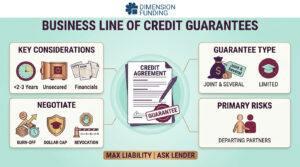
Personal Guarantee vs. Collateral: They Are Not the Same
A personal guarantee, collateral, and a UCC lien can all protect a lender, but each creates a different kind of exposure for the owner. A personal guarantee is an individual’s promise to take responsibility for the business’s debt if the business fails to pay. It sits outside the LLC or corporate shield that protects owners from most business liabilities.
Collateral is an asset pledged to secure the debt, and on default the lender may have rights to that property under the loan documents. The SBA’s standard Form 1059 security agreement defines collateral broadly. It can reach all tangible and intangible personal property, including inventory, equipment, accounts, and deposit accounts.
Unlimited and Limited Guarantees
The scope of a guarantee depends on its wording. An unlimited guarantee covers the full balance plus fees, legal costs, and collection expenses, with no ceiling. Joint and several language lets the lender hold each signing owner liable for the entire amount.
A limited guarantee caps exposure at a fixed dollar figure or a percentage of the balance. Lenders commonly offer one to minority owners or when strong collateral backs the line. Check whether collection costs count toward the cap or sit on top of it.
How UCC Liens Fit In
A UCC lien is different again. A UCC financing statement generally gives public notice of a lender’s security interest in personal property. Depending on the agreement, that interest can cover specific assets such as equipment or inventory, or a broader group of business assets through a blanket lien.
In SBA lending, lenders take a security agreement from the borrower and file a UCC-1 financing statement to secure a lien on the borrower’s assets, as attorneys at Starfield & Smith explain. The two documents work together to establish and protect the lender’s lien position.
Why Lenders Often Require Both
These protections are not necessarily alternatives. A lender can require collateral and a personal guarantee together, so business assets secure the line while the owner remains personally responsible for the guaranteed obligations. The SBA has noted that unsecured business funding often still requires a personal guarantee, even though no collateral backs the loan.
Before signing, ask whether the lender requires a personal guarantee, specific collateral, a blanket UCC lien, or a combination. Confirm which assets and obligations each document covers, because the credit limit alone cannot tell you how much personal exposure you are taking on.
Five Situations That Trigger the Requirement
Federal Reserve data shows how routine guarantees have become. According to the 2026 Small Business Credit Survey Report on Employer Firms, 59% of employer firms carrying debt had secured it with a personal guarantee, compared with 51% that pledged business assets.
Lines of credit draw extra scrutiny because the balance can rise at any time without a new application. The table below shows when a guarantee is most likely.
Trigger | Why the Lender Asks | What Can Reduce the Requirement |
Business under 2–3 years old | Short operating history to underwrite | Strong personal credit, larger equity stake |
Unsecured or lightly secured line | No hard asset to recover on default | Pledging receivables, inventory, or equipment |
Thin or inconsistent financials | Cash flow can’t be verified | Tax returns, bank statements, CPA-reviewed statements |
Closely held ownership | Owner and business finances overlap | Separate accounts, formal governance |
Government-backed program | Guarantee is a program condition | Generally none for qualifying owners |
Who Must Sign Under Federal Rules
Two sets of federal rules shape who can be asked to guarantee business credit. One applies to SBA-backed lines, and the other applies to nearly every lender.
The SBA 20 Percent Ownership Threshold
Under 13 CFR 120.160, owners holding at least a 20 percent stake generally must guarantee SBA loans. That rule follows owners into every SBA line of credit product.
A 2024 Federal Register notice states that SBA Express and Export Express lines top out at $500,000, while CAPLines and export working capital loans can reach $5 million. The same notice created the 7(a) Working Capital Pilot, which runs from August 1, 2024 through July 31, 2027.
Spousal Protections Under Regulation B
The CFPB’s official interpretation of Regulation B allows a lender to require guarantees from a business’s partners, directors, officers, and closely held shareholders even when the business is creditworthy, as long as the requirement rests on the guarantor’s relationship to the business. A lender also cannot automatically require a guarantor’s spouse to sign.
There is one exception. Under 12 CFR 1002.7, for secured credit, a lender may require a spouse’s signature on documents that state law requires to make pledged property available on default, such as an instrument creating a valid lien. Pledging a jointly owned home brings your spouse into the paperwork.
Why a Line of Credit Changes the Guarantee Math
A term loan has a fixed balance that shrinks with every payment, but a revolving line works differently. Most line of credit guarantees are continuing guarantees. They cover every draw made while the line stays open and typically survive renewals and limit increases unless the document says otherwise.
That creates real risk for co-owners and departing partners. An owner who sells a stake or leaves management can remain liable for later draws until the lender issues a written release.
Terms Worth Negotiating Before Signing
A burn-off clause reduces or removes the guarantee after the business meets agreed targets, such as a set period of on-time payments. A dollar cap limits exposure for minority owners. A revocation clause lets a guarantor stop coverage of future draws while staying liable for existing balances.
Renewal as a Release Point
Annual renewals give owners a natural opening to revisit the guarantee. Regulation B’s commentary says that when a lender reevaluates the borrower’s creditworthiness at renewal, it must decide whether an additional party is still warranted and release that party if not. This covers guarantors added because the applicant fell short of credit standards, so owners whose guarantees rest on ownership should not expect automatic release.
Financing Structures That Reduce Reliance on the Owner’s Signature
When the need ties to a specific purchase, equipment financing from Dimension Funding shifts the lender’s security toward the asset itself. Dimension Funding offers application-only financing up to $500,000 for software and $250,000 for equipment, with no financial statements required at those amounts and same-day or next-business-day funding through DocuSign.
The structure you choose shapes how your personal exposure behaves over time. A fixed balance tied to an asset is easier to measure than a revolving balance that can climb with each draw.
Feature | Revolving Line of Credit | Equipment or Software Financing | Working Capital Loan |
How the balance works | Rises and falls with draws | Fixed at funding | Fixed at funding |
Primary security | Owner guarantee, general business assets | The financed asset | Business cash flow |
Exposure over time | Can grow without a new application | Declines with each fixed payment | Declines with each fixed payment |
Best fit | Recurring, unpredictable cash gaps | Defined equipment or software purchases | One-time needs or seasonal bridges |
Signing With a Clear View of Your Exposure
A personal guarantee is a normal part of small business credit, but its terms are far from uniform. Before accepting a line, calculate your worst-case liability, confirm whether the guarantee is continuing, and ask which provisions the lender will adjust. Comparing a revolving line against fixed, asset-backed alternatives often reveals a structure with less open-ended personal risk.
Dimension Funding has spent more than four decades matching financing structure to purpose. It prefers two or more years in business, though strong credit can substitute. To compare your options side by side, Contact Dimension Funding at 1-800-755-0585 or Sales@DimensionFunding.com.
Frequently Asked Questions
Does a personal guarantee appear on my personal credit report?
In most cases, the guarantee itself is not reported while the business pays as agreed, though underwriting usually triggers a personal credit inquiry. If the lender later pursues you after a default, collection activity or a judgment can appear on your file.
What documents do lenders ask guarantors to provide?
Expect a personal financial statement and one to three years of personal tax returns. SBA lenders use SBA Form 413 for the financial statement.
What is a validity guarantee?
A validity guarantee, sometimes called a “bad boy” guarantee, makes an owner liable only for specific misconduct such as fraud, misreported collateral, or diverted receivables. It is common in asset-based lending.
Does a guarantee end if the business closes or files for bankruptcy?
No. A business bankruptcy can restructure the company’s debts, but the guarantor’s separate contract generally survives. Owners in this position should consult a bankruptcy attorney before the company files.
Can I buy insurance against a personal guarantee?
Specialty insurers sell personal guarantee insurance that reimburses a portion of losses if a guarantee is called. Policies usually cover a percentage of exposure, include waiting periods, and exclude fraud.
What happens to a guarantee if the guarantor dies?
Depending on the agreement and state law, the obligation can become a claim against the guarantor’s estate. Some continuing guarantees end coverage for future draws at death while existing balances stay enforceable.
Does living in a community property state change my exposure?
It can. In the nine community property states, including California, Texas, and Arizona, assets acquired during marriage are often treated as jointly owned. A lender may be able to reach marital property even if your spouse never signed.