

A profitable business can still struggle to pay its bills on a Tuesday. Revenue arrives in uneven waves, while rent, insurance, utilities, and vendor invoices come due on fixed dates. Dimension Funding, a business lender founded in 1978 with an A+ BBB rating, provides financing that helps owners cover routine expenses without draining reserves or relying on personal cards.
Dimension Funding offers financing up to $10M+, uses fully electronic DocuSign documents, and often funds approved requests the same day or the next business day. Owners who have mapped a shortfall in their weekly cash forecast can start by reviewing working capital loans designed for short-term operating needs.
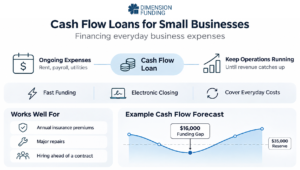
What Makes a Loan a Cash Flow Loan
A cash flow loan is evaluated mainly on the revenue and banking activity of the business rather than on a specific pledged asset. The lender asks whether incoming cash can comfortably support the payments, and repayment comes from ordinary operations. Many small business loans used for everyday expenses fall into this category.
Bank credit conditions have held steady in 2026. In the Federal Reserve’s July 2026 Senior Loan Officer Opinion Survey, banks reported basically unchanged standards for commercial and industrial loans to firms of all sizes, with small-firm standards easier than the midpoint of their historical range.
Where Small Businesses Finance Everyday Costs Today
Most owners already borrow for routine expenses, often informally. The Federal Reserve’s 2026 Report on Employer Firms found that 86% of firms use financing regularly, most often credit cards and loans. Among firms that regularly use a card, 58% use only a business card, 8% only a personal card, and 34% both.
That means 42% of card-using firms run some business spending through a personal card. The Internal Revenue Service notes that separate business and personal accounts make recordkeeping easier. Moving recurring costs onto a dedicated business loan or credit line keeps the books cleaner and builds a borrowing record in the company’s name.
Which Expenses Belong on a Cash Flow Loan
Financing works best for costs that are lumpy, temporary, or tied to future revenue. It works poorly for expenses that consistently exceed what the business earns, because borrowing only postpones that problem.
Expense Type | Good Fit for Financing? | Why |
Annual insurance premium paid upfront | Yes | Spreads one large payment across the months it covers |
Major repair that keeps operations running | Yes | Protects revenue that would stop without the fix |
Hiring ahead of a signed contract | Often | Revenue is committed, only the timing lags |
Rent that regularly exceeds monthly income | No | Signals a structural shortfall, not a timing gap |
Match the repayment period to the benefit period. An insurance premium covering 12 months fits a repayment window of about the same length, while a short cash dip fits a business line of credit repaid within weeks.
Build a Rolling Cash-Flow Forecast to Calculate the Actual Funding Gap
A business can earn enough over a quarter and still fall short when customer payments arrive after bills are due. A rolling 13-week cash-flow forecast shows when that shortfall will occur and how much financing is actually needed. The U.S. Small Business Administration’s financial management guidance is a starting point for managing business finances and monitoring cash availability.
Record Every Receipt and Payment by Week
Start with your opening cash balance. Then record expected customer receipts and every major outgoing payment by date, including rent, payroll, vendor invoices, existing loan payments, taxes, and utilities. Use realistic collection dates rather than invoice due dates, and update the forecast weekly as invoices clear.
Week | Opening Cash | Receipts | Payments | Closing Cash | Gap Below $35,000 Reserve |
1 | $65,000 | $40,000 | $82,000 | $23,000 | $12,000 |
2 | $23,000 | $30,000 | $34,000 | $19,000 | $16,000 |
3 | $19,000 | $55,000 | $41,000 | $33,000 | $2,000 |
4 | $33,000 | $48,000 | $30,000 | $51,000 | None |
Size the Gap Below Your Reserve
Week 1 looks like the problem, with $82,000 in rent, payroll, vendor payments, and debt service. The lowest balance actually falls in Week 2, however, so the funding gap is $16,000, not $12,000. Borrow against the largest shortfall below your minimum reserve across all 13 weeks. Subtract any credit already available to you, and count the repayments that existing financing will require.
Test Delays and the New Payment
Rerun the forecast with customer payments delayed by 15 days. If the shortfall grows substantially, consider a larger credit facility or revised payment terms with vendors. Then add the proposed loan payment into each week and check the slowest month’s debt service coverage, meaning cash available before debt payments divided by total debt payments. A ratio comfortably above 1.0 suggests the payment fits. Dimension Funding’s payment calculator can estimate that payment first.
Repayment Frequency Matters as Much as Amount
Two loans of the same size can affect a weekly forecast very differently depending on how often payments are withdrawn. A weekly schedule produces 52 debits a year, so four months each year carry five payments instead of four.
Payment Schedule | Debits Per Month | Effect on Everyday Cash Flow |
Daily (business days) | About 21 | Withdrawals continue through slow weeks |
Weekly | 4 or 5 | Four months a year carry an extra debit |
Fixed monthly | 1 | Easiest to forecast alongside rent and payroll |
Dimension Funding structures its financing around one fixed monthly payment, which lines up with how most operating expenses are billed. Predictability matters, since 60% of firms borrowing from online lenders said their actual borrowing costs ran higher than expected.
What Lenders Read in Your Bank Statements
Bank statements show how cash actually moves. Reviewers typically look at average daily balances, deposit consistency, overdrafts or returned payments, existing loan debits, and customer concentration. Bring your 13-week forecast as well, since it shows the lender exactly when the gap opens and closes.
Dimension Funding generally prefers two or more years in business, though strong credit can offset a shorter history. Its team brings more than four decades of business lending experience, outlined on the About Us page. Requests can start through the online financing application.
Keeping Everyday Expenses Off the Owner’s Personal Balance Sheet
Routine bills should not depend on lucky timing or a personal credit card. A cash flow loan sized to the lowest point in a rolling forecast, tested against your slowest month, and repaid on a predictable schedule keeps core operations steady while revenue catches up.
If your forecast shows a gap below your operating reserve, Contact Dimension Funding to talk through amount, term, and payment structure. You can also call 1-800-755-0585 or email Sales@DimensionFunding.com.
Frequently Asked Questions
Is a cash flow loan the same as a merchant cash advance?
No. A merchant cash advance is usually structured as a purchase of future receivables rather than a loan, so it may fall under different state rules and disclosure practices. A cash flow loan is a borrowing arrangement with a defined repayment schedule.
Will a cash flow loan affect my personal credit?
It can, depending on whether you sign a personal guarantee. Guarantees are common, since 59% of small firms with debt used a personal guarantee to secure it. Ask upfront whether one is required and how the account will be reported.
Can I use a cash flow loan to pay off business credit card balances?
Yes. Many owners do this to replace a revolving balance with a fixed repayment schedule. It works best when the cards are then used only for purchases paid in full each month, so new balances do not build up alongside the loan.
Do lenders ask how the money will be used?
Usually, yes. Proceeds for everyday expenses are generally flexible, but lenders want the stated purpose to match the amount and term requested. A brief explanation, such as covering an annual premium, helps the review move faster.
What if I recently switched banks?
Provide statements from both the old and new accounts so the lender sees a continuous history. A new account with only a few months of activity can make revenue look smaller or less consistent than it really is.
Can a seasonal business qualify if revenue drops for several months?
Often, yes. Lenders reviewing a seasonal business typically look at a full 12-month cycle rather than a single slow quarter. Prior-year statements showing the same pattern help show that the dip is predictable and temporary.
Are loan payments tax-deductible?
Principal repayment is not a deductible expense. The business costs the loan pays for, such as insurance or repairs, generally remain deductible when they are ordinary and necessary. Ask your CPA how financing charges should be treated for your business.