

A staffing agency pays its temporary workers every Friday, and the client who uses those workers pays 45 days after the invoice. Every new placement widens that gap before it earns a dollar back. Dimension Funding has financed service businesses since 1978, and funding weekly payroll against slow client terms is one of the most common reasons staffing firms look for working capital.
The mismatch can be measured precisely, client by client. Agencies that know how many payrolls they carry before a client’s first payment can plan growth instead of reacting to it, and a Dimension Funding working capital loan can cover the gap those terms create.
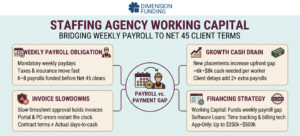
Why Weekly Payroll and Net 45 Terms Collide
Staffing agencies are the employer of record for their temporary workers, so wages come due on the agency’s payday regardless of when the client pays. In many states, the law also sets how often wages must go out. The Department of Labor’s state payday requirements table shows, for example, that New York requires weekly pay for manual workers and Massachusetts requires hourly employees to be paid weekly or biweekly.
Clients, by contrast, often pay on net 30, net 45, or longer terms. The industry is large enough that these terms shape a real share of the labor market. According to the American Staffing Association’s data dashboard, temporary help employment made up 1.58% of total nonfarm employment in July 2026.
Client DSO Does Not Equal the Payroll Funding Cycle
A staffing agency with net 45 terms does not necessarily have a 45-day payroll funding requirement. Days sales outstanding (DSO) measures how long, on average, it takes to collect receivables after a sale, and averages can mislead. A Staffing Industry Analysts column citing its Pulse survey reported that staffing DSO averaged 45.1 days across 109 firms, well above the median range of 30 to 39 days.
The agency’s actual cash exposure starts when it pays workers and ends when the matching client cash arrives. That window can be shorter or longer than the contract term, depending on timesheet approval, invoice submission, payroll frequency, and how the client actually pays.
Measuring the Gap by Payroll
Payroll funding gap = client cash-receipt date − agency cash-out date
Assume a workweek ends Friday (day 0), timesheets are approved Monday (day 3), and the invoice is submitted Tuesday (day 4). Workers are paid the following Friday (day 7), and the client pays 45 days after invoicing, on day 49. The first payroll’s funding gap is 42 days, and the agency funds every payroll that falls between that first payday and the client’s payment.
Payroll | Paid on Day | Client Pays Day 49 (On Time) | Client Pays Day 59 (10 Days Late) |
Week 1 | 7 | Funded | Funded |
Week 2 | 14 | Funded | Funded |
Week 3 | 21 | Funded | Funded |
Week 4 | 28 | Funded | Funded |
Week 5 | 35 | Funded | Funded |
Week 6 | 42 | Funded | Funded |
Week 7 | 49 | Same day as payment | Funded |
Week 8 | 56 | Funded |
An on-time client means six payrolls clear before the first payment, with a seventh landing the same day. A client with the same net 45 terms that consistently pays 55 days after invoicing pushes that to eight. DSO captures the broader collection pattern, but this timeline shows exactly how many payroll cycles you must finance for each client.
Tracking Each Major Client
For each major client, track the timesheet approval date, invoice date, contractual due date, actual payment date, and matching payroll dates. That converts a general DSO figure into a client-specific funding requirement. It also shows how much cash a new placement contract will consume before its first payment arrives.
Tax Deposits Leave Within Days
Payroll taxes move even faster than wages. According to IRS guidance on employment tax deposits, semiweekly schedule depositors have at least three business days after each semiweekly period to deposit. Any employer that accumulates $100,000 or more in taxes on a single day must deposit by the next business day, and becomes a semiweekly depositor for the rest of that year and the next.
Why Growth Consumes Cash
In staffing, winning a new client makes the cash gap bigger before it makes the business stronger. Every added worker brings a full stack of payroll cycles that must be funded before the first invoice is paid.
Consider a worker paid $22 an hour for 40 hours, or $880 a week. With an illustrative 18% load for employer payroll taxes, unemployment insurance, and workers’ compensation, the weekly cost is about $1,040. At six payroll cycles, each added worker needs about $6,240 of cash before the first payment, and at eight cycles, about $8,320.
New Placements | Weekly Loaded Payroll | Cash Needed, Client Pays on Time | Cash Needed, Client Pays 10 Days Late |
10 workers | $10,400 | $62,400 | $83,200 |
25 workers | $26,000 | $156,000 | $208,000 |
50 workers | $52,000 | $312,000 | $416,000 |
On a 25-worker contract, the difference between an on-time client and one that pays 10 days late is about $52,000.
Where the Invoice-to-Cash Chain Slows
Net 45 terms describe when the client should pay after receiving a valid invoice. Several steps around the invoice can add payroll cycles without any change to the contract.
Timesheet Approval
The invoice usually cannot go out until the client’s supervisor approves hours. If approvals slip a week, the invoice goes out a week later and the agency funds one more payroll cycle on every placement with that client. Approval deadlines in the client agreement and automated reminders keep invoicing on schedule.
Client Portals and Invoice Rejections
Many larger clients require invoices through a vendor management system or procurement portal. A missing purchase order number or mismatched job code can send an invoice back, and payment terms often restart when the corrected invoice is accepted.
Financing Placement Growth Without Missing a Payday
A working capital loan fits the defined need a new contract creates: the payroll cycles for its placements until client payments arrive on a regular schedule. Sizing it from your client-level timeline, using your own wages and each client’s payment history, keeps borrowing tied to real placements. Short-term business loans can cover a narrower need, such as the first eight weeks of a seasonal contract.
Systems that speed approvals and invoicing also shorten the gap. Software financing can spread the cost of applicant tracking, time capture, and payroll platforms over fixed payments. Dimension Funding offers application-only software financing up to $500,000 with no financial statements required, and funding typically arrives the same day or the next business day through DocuSign.
Keeping Paydays on Schedule as the Business Grows
Weekly pay and net 45 terms will always create a gap, but the gap is measurable. Track each client’s timeline from payday to payment, count the payroll cycles it creates, and watch the approval and invoicing steps that quietly add weeks.
Dimension Funding prefers businesses with two or more years in operation, though strong credit can substitute. To size financing around your placement growth, Contact Dimension Funding at 1-800-755-0585 or Sales@DimensionFunding.com.
Frequently Asked Questions
Can I move temporary workers to biweekly pay to ease cash flow?
It depends on state law and your workforce. Some states require weekly pay for certain workers, and slower pay can make recruiting and retention harder.
What happens if a client disputes hours after payroll has run?
Wages for hours worked are still owed to the worker. Written sign-off rules with a short dispute window keep one disagreement from holding up the full invoice.
Should I offer clients a discount for paying early?
An early-pay discount can remove several payroll cycles, but it reduces margin on every invoice. Compare the discount with the cost of carrying those extra cycles for that client.
Do lenders look at client concentration?
Often, yes. An agency with one client producing a large share of revenue carries more risk if that client slows payment or ends the contract.
How do workers’ compensation audits affect cash?
Premiums are often estimated at the start of the policy year and audited against actual payroll afterward. Rapid growth can produce an additional premium bill after the audit.
Is invoice factoring the same as a working capital loan?
No. Factoring sells or assigns invoices, and clients are typically instructed to pay the factoring company. A working capital loan is repaid on a set schedule and does not change how clients pay you.
How do daily pay or earned wage access programs affect the gap?
Programs that let workers draw earned wages before payday move cash out earlier. If the agency funds those advances, the funding gap for each payroll grows by those days.