

A practice pays its staff every two weeks whether or not a single claim has cleared. For medical, dental, and therapy practices, the gap between delivering care and receiving insurance payment is often the biggest financial pressure point, even with a full schedule. Dimension Funding has financed medical practices and other businesses since 1978, and reimbursement lag is one of the most common reasons practices look for working capital.
The gap is predictable enough to plan around. Practices that understand where payment delays come from can size their need accurately and choose a Dimension Funding working capital loan or other financing that covers the wait without draining reserves.
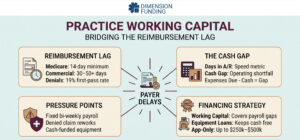
Why Reimbursement Timing Creates a Cash Gap
A practice’s costs arrive on a fixed calendar, while its revenue arrives on the payer’s calendar. Payroll, rent, supplies, and software subscriptions come due on set dates. The payer’s clock starts only after a claim is coded, submitted, and accepted, so even a clean claim waits in a queue before payment is released.
Medicare sets clear boundaries. According to First Coast Service Options, a Medicare Administrative Contractor, Medicare has 30 days to pay a clean claim but cannot pay electronic claims before day 14 or paper claims before day 29. Commercial payers follow their contracts and state prompt-pay rules, which vary by state.
Timelines Differ by Payer
A practice’s overall payment speed is a blend of very different payer timelines. The AAFP gives the example of a practice averaging just under 50 days in A/R while its Medicaid claims average 75 days. A practice with a large share of slow-paying payers can feel a cash squeeze even when its overall numbers look acceptable.
What Slows Payment After the Claim Leaves the Office
The Medicare payment floor is the best case. Most practices wait longer, because a share of claims does not go through on the first submission.
Denials and Rework
KFF’s analysis of 2024 federal transparency data found that insurers selling plans on HealthCare.gov denied 19% of in-network claims. Where insurers gave a reason, administrative issues accounted for 25% of denials, while lack of prior authorization or referral accounted for 9%.
A denied claim must be corrected, resubmitted, or appealed, and the payment clock effectively restarts. Administrative denials are the most preventable, which makes front-desk data accuracy and eligibility checks a cash flow issue as much as a billing one.
Manual Claim Follow-Up
A CAQH issue brief on the claim status transaction puts the cost of a manual claim status inquiry at $15.96. It reports electronic adoption of that transaction at 74% for medical providers but only 28% for dental providers, so dental practices spend more staff time per dollar collected.
Payment Plans and Collections Accounts
Patient payment plans extend how long balances stay open, which can inflate days in A/R without signaling a payer problem. The AAFP suggests tracking payment-plan patients as a separate “payer.” It also recommends calculating days in A/R with and without accounts sent to collections, so the number reflects insurance timing rather than patient bad debt.
Days in A/R Does Not Equal the Cash Gap
A practice’s days in accounts receivable (A/R) and its working capital gap answer two different questions. The American Academy of Family Physicians (AAFP) defines days in A/R as the average number of days it takes a practice to collect payments due, and it pairs the metric with collection and denial rates. It also warns that a healthy overall average can hide slow-paying carriers and receivables aged past 90 or 120 days.
That makes days in A/R a revenue cycle measurement, not a borrowing target. A practice with 40 days in A/R does not necessarily need financing equal to 40 days of charges. Some receivables will arrive before the next payroll, and existing cash may already cover part of the remaining delay.
Where the Money Is Waiting
A payer-by-payer view shows how long money takes to arrive. The example below uses illustrative assumptions for a practice expecting $200,000 in monthly collections, with a denial share modeled on the KFF figure.
Payer Segment | Expected Monthly Collections | Assumed Days to Payment |
Medicare, electronic clean claims | $80,000 | 22 |
Commercial, paid on first submission | $72,900 | 38 |
Commercial, denied and reworked | $17,100 | 75 |
Patient balances | $30,000 | 60 |
Weighted average | $200,000 | About 38 |
The 38-day weighted average falls within the AAFP’s preferred range of 30 to 40 days. Even so, the denied and reworked slice accounts for only 8.5% of the dollars but drives about 17% of the total delay. The AAFP puts the industry-average denial rate at 5% to 10%, so a practice denied at the marketplace rate has real room to shorten its wait.
Sizing the Operating Shortfall
The more useful financing question is how much operating cash the practice must fund before its expected reimbursements arrive. Suppose a practice has $300,000 in A/R and 40 days in A/R. Its payroll, rent, supplies, and other expenses require $120,000 before the next expected insurance payments land.
Item | Amount |
Outstanding A/R | $300,000 |
Operating expenses due before expected payments arrive | $120,000 |
Cash already available | $75,000 |
Potential cash gap | $45,000 |
Measure | What It Tells You |
Days in A/R | How long money is taking to arrive |
Cash gap | How much operating cash is needed while waiting |
In this example, the cash gap is $45,000, far smaller than the $300,000 A/R balance. Size financing around the timing and amount of the operating shortfall, not the total value of outstanding claims. A payer-specific A/R review then shows whether the gap reflects normal reimbursement timing or a growing collections problem.
Why Emergency Payer Relief Is Not a Cash Plan
The 2024 Change Healthcare cyberattack showed how quickly reimbursement can stop. The CMS fact sheet on Change Healthcare/Optum payment disruption describes accelerated and advance payments of up to 30 days of claims payments, repaid through automatic recoupment from Medicare claims over 90 days.
The relief was temporary and came with conditions. As the American Hospital Association summarized CMS’s FAQs, providers had to certify that they had obtained or tried to obtain emergency financing or advances from other sources. Recoupment then reduced incoming payments for three months, which opened a second gap after the first one closed.
Financing That Fits a Practice’s Timing
A working capital loan fits a defined reimbursement gap, such as a new payer contract ramping up or a denial backlog being worked down. Medical equipment financing and medical software financing keep capital purchases on fixed payments, so reimbursement dollars stay available for payroll.
Dimension Funding offers application-only financing up to $500,000 for software and $250,000 for equipment, with no financial statements required at those amounts. Funding typically arrives the same day or the next business day through DocuSign, and practices with two or more years in operation are preferred, though strong credit can substitute.
Keeping Capital Purchases Separate
Paying cash for equipment can turn a manageable gap into a serious one. In the sizing example above, a $60,000 imaging upgrade paid from available cash would wipe out the $75,000 cushion and raise the shortfall from $45,000 to $105,000.
Financing the upgrade separately keeps the reimbursement gap at its true size. The practice then borrows only what the timing of collections requires.
Keeping Care Running While Claims Catch Up
Reimbursement lag is a timing problem with measurable parts. Track days in A/R by payer, measure the operating shortfall separately, and keep equipment and software purchases on their own financing so collections can cover operating costs. Practices that review these numbers monthly can spot a growing gap before it reaches payroll.
To size financing around your practice’s actual cash gap, Contact Dimension Funding at 1-800-755-0585 or Sales@DimensionFunding.com.
Frequently Asked Questions
Can a practice borrow against its insurance receivables?
Some lenders finance healthcare receivables, but Medicare generally prohibits paying a provider’s claims to anyone other than the provider, with limited exceptions. That restricts how Medicare receivables can be sold or factored. Commercial receivables depend on each payer contract.
Does enrolling in electronic payments speed up reimbursement?
Enrolling in electronic funds transfer and electronic remittance advice with each payer removes mail time and speeds payment posting. Medicare’s shortest payment floor applies only to electronic claims, so paper workflows add weeks.
What will a lender want to see from a practice?
Expect requests for an A/R aging by payer and a short cash forecast showing expenses due before expected payments arrive. Together they show the lender whether the need comes from timing or from collectability.
How does payer credentialing affect a new practice’s cash?
Credentialing with insurers often takes several months, and claims may not be payable until enrollment is complete. New practices, and groups adding new providers, should budget working capital for that window.
Why do patient balances slow collections?
Deductibles and coinsurance shift part of each visit’s revenue to patients, and those balances typically collect more slowly than insurance payments. Collecting estimated patient responsibility at check-in shortens that segment.
What happens when a payer recoups an overpayment?
A payer may offset an overpayment against future payments, reducing deposits with little notice. Treat recoupment letters as scheduled cash outflows in your forecast, just like payroll or rent.
Should a practice delay vendor payments instead of financing the gap?
Stretching supplier payments can preserve cash briefly, but it risks losing favorable terms or priority service. Financing a measured gap is usually more predictable than shifting it onto vendors.