

A $10,000 cash flow gap can be covered more than one way. Most business owners just reach for whatever card is in their wallet, without comparing what that draw actually costs to carry.
Dimension Funding works with businesses weighing this exact choice: a dedicated line of credit versus a business credit card. Both are revolving. Both can fund a $10,000 need. But they’re structured very differently once that draw is on the books.
Both products are common. In 2023, 56% of employer firms used business credit cards regularly, compared with 34% for lines of credit and 53% for business loans, per Federal Reserve survey data. That overlap is exactly why the comparison is worth making before your next gap shows up.
The tricky part is that neither product is inherently cheaper. The right answer depends on what the $10,000 is for, and how fast you can realistically pay it back.
How the Two Products Structure Cost Differently
A line of credit is built around draws. You’re approved for a limit, pull what you need, and repay that draw on its own schedule. Cost is tied to the amount pulled and how long it’s outstanding — not the size of your full limit.
A credit card works differently. Purchases pile into one balance. A grace period — the window where a fully-paid balance carries no added cost — usually only applies if you pay the statement in full each cycle. Carry $10,000 past that window, and it starts behaving like a running tab instead of a one-time draw.
That distinction matters more than it sounds. A line of credit treats every draw as its own event with its own clock. A credit card treats every new charge as an addition to whatever’s already sitting on the account, which can make it harder to isolate the cost of any one $10,000 draw once other purchases are mixed in.
What “Cost per $10,000” Actually Depends On
The real driver isn’t the product category. It’s how the $10,000 gets used and repaid.
A line draw has a predictable cost curve, since the amount and timeline are fixed at the start. A card balance depends entirely on how much you pay down each cycle — the same $10,000 can cost very different amounts depending on whether it’s cleared in one cycle or left rolling for months.
Fees diverge sharply too. Lines sometimes carry a draw fee or unused-line fee, but rarely one tied to how the funds were accessed. Cards are the opposite: a $10,000 purchase and a $10,000 cash advance on the same card can carry completely different fees, even though both draw down the same $10,000 from the same account.
Where Credit Cards Add Hidden Cost
If the $10,000 is a purchase — inventory from a vendor that takes cards, say — a grace period can make it effectively free to carry, as long as you pay it off before the due date. That’s an edge a line of credit doesn’t offer.
The picture flips if you pull the $10,000 as a cash advance instead. Cash advances usually carry an upfront fee, and the grace period doesn’t apply — cost starts from day one. The CFPB’s own research on cash advance fees found cardholders are often caught off guard by these charges, partly because issuers don’t always clearly disclose which transactions count as a cash advance. That upfront fee alone can eat into a meaningful chunk of the total cost, sometimes before any ongoing balance is even factored in.
A Quick Example Worth Running Through
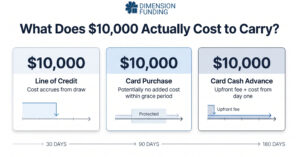
Say a $10,000 draw sits outstanding for 90 days either way. As a card purchase paid off within the grace period, it costs nothing extra. As a card cash advance, it starts with an upfront fee plus 90 days of cost with no grace period to soften it. As a line of credit draw, it costs 90 days of carrying cost on a fixed schedule, with no separate upfront fee.
None of these numbers are fixed — they depend entirely on your specific card terms and your line’s pricing. But laying the three paths side by side like this is usually enough to show which option actually fits a given need, rather than defaulting to whichever product is already open.
Where a Line of Credit Wins at $10,000
A line draw doesn’t carry a cash-advance-style fee for being cash rather than a swipe — the whole product is built around cash draws. Federal Reserve Bank of Chicago research on small business credit found satisfaction with bank-sourced financing tends to run high, which likely reflects that more predictable draw-and-repay structure.
Larger draws are also easier to manage on a line built for that purpose. A $10,000 draw against a $50,000–$100,000 line leaves plenty of room, without pushing utilization into a range that could affect future credit decisions.
How Repayment Speed Changes the Real Cost
The true cost of $10,000 depends less on the product and more on how fast you repay it. “Cards are cheaper if paid off fast” isn’t automatically true — it depends on the actual repayment timeline.
A card purchase can be carried at no added cost if paid in full before the due date. CFPB explains a grace period as the gap between your billing cycle ending and the due date, during which a fully-paid balance costs nothing extra — though issuers aren’t required to offer one. That protection is narrower than it sounds: it typically applies to purchases only. Cash advances start accumulating cost immediately.
A line draw works differently from either. It starts costing you from the date it’s drawn, with no grace period — but it also skips the upfront fee a cash advance carries. Actual costs still vary by lender.
Time Outstanding | Line of Credit* | Card Purchase | Card Cash Advance |
30 days | Cost accrues for 30 days | Often free within grace period | Cost from day one, plus fee |
90 days | Cost accrues for 90 days | Cost starts once grace period ends | Cost continues, plus fee already charged |
180 days | Cost accrues for 180 days | Cost continues on remaining balance | Cost continues, plus fee already charged |
*Actual costs vary by lender and fee structure.
Bottom line: if a $10,000 purchase can be repaid before the due date, a card can be cheaper. If it needs to sit outstanding for weeks or months, a line of credit is more predictable. Either way, compare total dollar cost over the expected repayment period — don’t assume one category wins automatically.
When Businesses Mix Both Products
Plenty of businesses don’t pick one product and stick with it for everything. A common pattern is running vendor purchases through a card to capture the grace period, while keeping a line of credit open specifically for draws that need to sit outstanding longer.
That split isn’t about complexity for its own sake. It’s about matching each dollar to the structure that actually fits how long it’ll be owed. A $10,000 inventory order paid off in three weeks and a $10,000 payroll gap that takes two months to close out don’t belong on the same kind of credit, even if both technically fit on either product.
Choose the Right Tool for Your Next Draw
Neither product wins automatically. It comes down to whether your $10,000 need is a purchase you can pay off quickly, or a gap that needs to sit outstanding for a while. Businesses that regularly need cash rather than card purchases tend to find a dedicated line more predictable. Contact Dimension Funding to see how a working capital line compares to what you’re carrying on cards.
FAQs
Is a $10,000 cash advance ever cheaper than a line draw?
Depends on how fast it’s repaid. Cash advances carry an upfront fee and no grace period, so a line draw repaid over a similar timeframe is usually more predictable — though an advance repaid within days can sometimes cost less overall, since the fee is a flat percentage rather than something that compounds daily.
Does a card purchase ever cost nothing extra?
Yes — if you pay the full statement balance by the due date, that $10,000 purchase carries no added cost. That advantage disappears the moment any part of the balance rolls into the next cycle, which is why timing the payoff matters more than the purchase amount itself.
Can I use both a card and a line for the same need?
Yes. Some businesses split it: card for purchases that qualify for a grace period, line of credit for the portion that needs to sit outstanding longer. That combination can lower total carrying cost compared to putting the whole amount on one product.
Does drawing on a line affect my card’s utilization?
No. Card utilization is calculated against that card’s own limit and balance. A line draw doesn’t factor in directly, though lenders reviewing your overall creditworthiness may still weigh both balances together when deciding on future financing.
Does a partial payment protect the grace period?
Generally no. Most issuers require the full statement balance to preserve the grace period on new purchases. Paying only part usually means the remaining balance — and often new purchases too — start costing you right away, not just the unpaid portion.
Are line draw fees one-time or recurring?
Varies by lender. Some charge per draw; others charge based on unused capacity instead. Worth confirming the specific structure before assuming either product is the default choice, since the fee model can shift which option is actually cheaper for your situation.
Does draw size change which product makes sense?
Generally yes. Smaller draws repayable within one billing cycle favor a card’s purchase grace period. Larger draws, or ones expected to sit outstanding for weeks, favor a line of credit, partly because the fixed repayment schedule makes planning around a bigger number easier than watching a revolving card balance.