
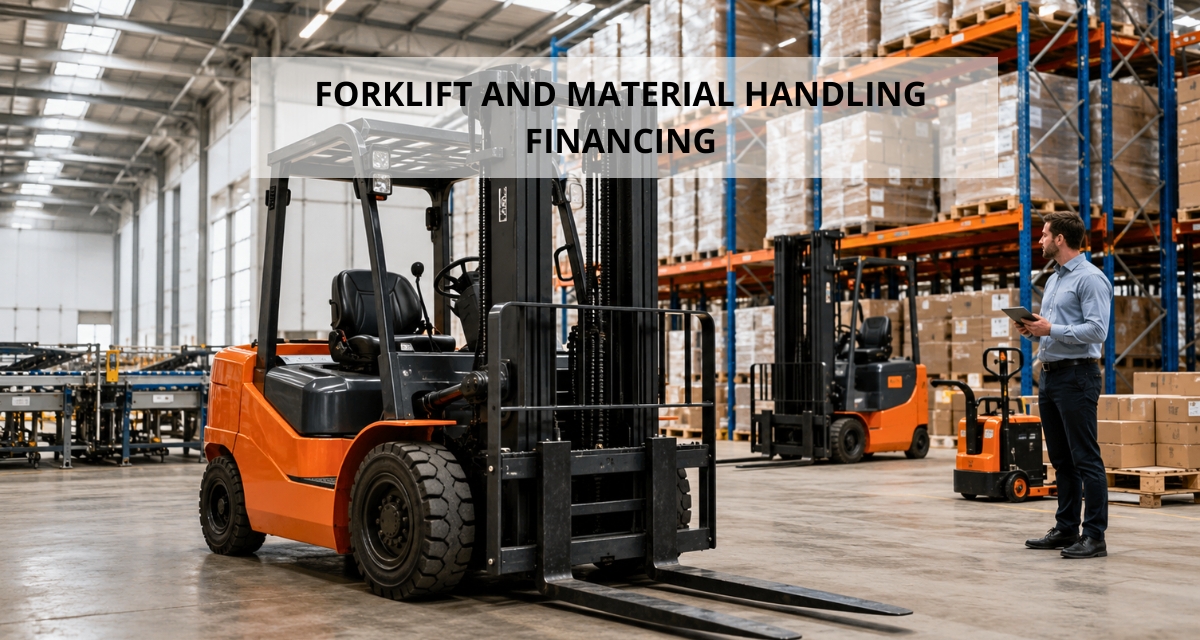
Forklift and Material Handling Financing for Dealers
Material handling equipment moves fast, or at least it’s supposed to. A dealer with the right forklift, racking system, or conveyor line in stock should be able to close a sale in days instead of weeks. What usually gets in the way is rarely the equipment or the price. It’s whether the dealer walks in with a financing answer already in hand, or leaves the buyer to go find one on their own.
Dealers selling forklifts, pallet trucks, order pickers, warehouse racking, conveyors, and packaging equipment can put that answer directly into the quote through Dimension Funding‘s vendor partner program, built around how material handling deals operate: fast decisions, tight timelines, and buyers who often can’t wait on a bank’s underwriting cycle.
Why Material Handling Runs on a Different Clock
Material handling purchases move on a shorter timeline than most commercial equipment financing is built to accommodate. A financing process that takes weeks rather than days can kill a sale regardless of price.
According to the Industrial Truck Association, the industrial truck industry generated a total GDP impact of $36.6 billion in 2023 and supported more than 257,000 jobs—a scale that reflects how much of this equipment moves through dealers tied to active warehouse operations rather than a slow capital-planning cycle. The 2025 MHI Annual Industry Report found that 42% of supply chain leaders surveyed planned to invest in forklifts and handling equipment.
What a Dealer Sells Under the Program
Rolling Stock and Fixed Systems
Most of what a material handling dealer carries qualifies for Dimension Funding’s program, which has run vendor partnerships across equipment and material handling dealers for over 40 years. New or used, it all runs through the same structure.
- On the equipment side: lift trucks, pallet jacks, platform trucks, order pickers, and side loaders.
- On the fixed-infrastructure side: warehouse storage racks, shelving, cranes, conveyors, and hoists.
- On the packaging side: filling, labeling, palletizing, and wrapping systems.
Installation and labor costs can be included in the same monthly payment as the equipment itself. That’s important for a racking system or conveyor line in particular, since the labor to install and commission it can run close to the cost of the equipment. A buyer comparing cash against financing should be looking at the full project cost rather than a stripped unit price.
Why Rolling Stock and Fixed Systems Don’t Share a Term
Rolling stock and fixed infrastructure age differently, which is worth factoring into term length rather than defaulting to the same structure for both. A forklift fleet is also in the middle of a real shift in the equipment itself. Mordor Intelligence’s US Forklift Market report found that lithium-ion battery systems held 54.62% of US forklift market revenue in 2025 and are forecast to keep growing through 2031. That kind of shift can affect how long a buyer wants to hold a given unit in a way that wasn’t really a factor with combustion fleets.
Racking, conveyors, and other fixed systems don’t carry that same pressure. A conveyor line installed this year isn’t getting displaced by a battery chemistry change the way a forklift might be. Dimension Funding structures both under the same up-to-60-month terms, but that full term is worth a second look for a rolling-stock order rather than defaulting to it the way it might for fixed infrastructure.
The Software Riding Along With the Hardware
Warehouse equipment increasingly ships with a software layer attached: a WMS upgrade, an inventory tracking platform, or fleet management software for a growing lift truck fleet. That software can be bundled into the same financed transaction as the equipment. A dealer partnering with a software vendor on the deal can consolidate both into one agreement instead of two separate purchase decisions.
The US Forklift Market report from Mordor Intelligence points to why that software layer keeps showing up in these deals. The report notes that 90% of logistics providers now budget for digital supply chain upgrades, and that end-users increasingly evaluate forklifts on data compatibility as much as lift capacity.
Bringing a Program Online
A vendor partner application is the starting point, and from there Dimension Funding builds the structure around specifics: how big a typical order runs, what a dealer’s buyer base looks like, and how quickly deals usually need to move from quote to close. No in-house finance team required on the dealer’s end.
Marketing materials and sales support come with an active partnership, so financing sits inside the standard quote instead of getting raised only when a buyer brings up price.
Getting Paid Without Carrying the Risk
A dealer quotes the equipment, the buyer submits an application, and once approved, Dimension Funding pays the dealer the full purchase price directly. The dealer isn’t carrying the paper, isn’t chasing a monthly payment, and isn’t exposed if the buyer’s business hits a rough stretch later in the term. Applications run electronically, with signatures through DocuSign, so a deal that’s ready to close doesn’t sit waiting on paperwork.
The numbers worth knowing before a sales conversation:
- Up to $250,000: application-only financing, no financial statements required.
- Above $250,000: still available and still streamlined, though some financial documentation is needed.
- Terms: fixed payments extending up to 60 months, spreading a full project cost, including installation, over the equipment’s working life.
- Credit: most credit types accepted, Tier A down to marginal.
- Timeline: approvals usually returned within a few hours, with funding typically following in two to three business days.
Dealers can run rough numbers for a buyer through Dimension Funding’s payment calculator before formal approval.
Cash vs. Financing for a Fleet Purchase
Paying cash for a fleet of reach trucks or a full racking system ties up capital that could otherwise cover payroll during a seasonal ramp-up or an unplanned repair.
Section 179 adds a tax incentive on top of it. Under current IRS rules, qualifying equipment placed in service during a tax year beginning in 2026 can be deducted up to $2,560,000 in the year of purchase, phasing out dollar-for-dollar above $4,090,000 in total qualifying purchases and disappearing entirely above $6,650,000, according to Section179.org.
Both new and used material handling equipment qualify. A buyer financing the purchase can take the full deduction in year one while the actual cash payments are spread across the term, which is often the detail that turns a “maybe next quarter” into a signed order before year-end.
Financing as Part of the Quote, Not an Afterthought
A dealer selling a mix of new and used equipment, or bringing a software vendor into the deal, doesn’t need a separate conversation for each scenario. Dimension Funding has worked with equipment and material handling dealers for over 40 years, and the fastest way to see how a partnership would work for a specific product line is to ask directly. Contact Dimension Funding to get started.
Frequently Asked Questions
If an order combines new and used equipment, does the mixed total still count toward the $250,000 application-only threshold, or is the used portion evaluated separately?
The combined order amount is what counts, not new and used values evaluated separately. A quote combining $180,000 in new forklifts with $60,000 in certified pre-owned units still falls under one application-only threshold as a single $240,000 transaction, rather than being split into two.
At what point does the dealer get paid: when the buyer signs, when the equipment ships, or after installation?
Funding generally follows a sequence rather than a single moment.
At application: the buyer applies and the credit decision comes back within hours.
At signing: documents are executed electronically through DocuSign once approved.
At funding: payment to the dealer follows within two to three business days of that signed agreement, typically tied to confirmation that the equipment has been delivered.
Does the dealer have to relay financial details back and forth between the buyer and Dimension Funding, or does the buyer apply directly?
The buyer applies and submits any required documentation directly, so the dealer isn’t stuck in the middle of a credit conversation or handling sensitive financial paperwork on someone else’s behalf. That keeps the dealer’s role limited to the sale itself, with the underwriting conversation happening independently between the buyer and Dimension Funding.
Can a large order, like a fleet of ten forklifts, be financed if the units are delivered in batches over several weeks rather than all at once?
Multi-unit orders are common in this category, and a staggered delivery schedule doesn’t require splitting the purchase into separate financing agreements. The full order can typically be structured as a single financed transaction, with funding tracking the delivery schedule rather than requiring every unit on-site before the deal can close.
If a buyer is trading in older equipment as part of a new purchase, does that complicate the financing?
Not typically. A trade-in simply reduces the amount being financed, and the remaining balance moves through the same application-only process as a standard purchase. Dealers handling trade-ins don’t need to structure the financing side any differently than they would for a straightforward sale.
Is there a minimum order size to make a vendor partnership worthwhile for a dealer?
No fixed minimum applies. Programs are built around how a specific dealer sells, whether that’s occasional single-unit sales to small operations or recurring fleet deals with larger distribution and logistics accounts.
Does a buyer who’s already financed equipment through Dimension Funding move faster on a follow-on order?
Generally, yes. An existing financed relationship gives Dimension Funding payment history to reference, which typically speeds up approval on a follow-on purchase. That also gives a dealer a legitimate reason to check in with past buyers ahead of a fleet expansion or seasonal add-on.