
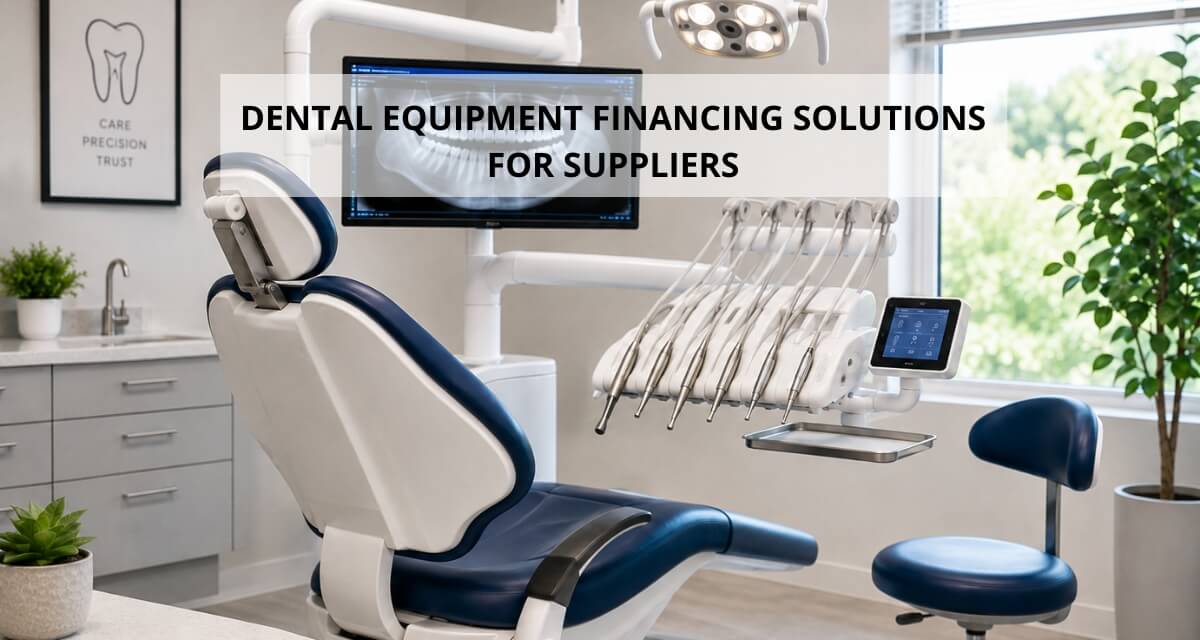
Dental Equipment Financing for Suppliers | Dimension Funding
Dental equipment financing for suppliers works through vendor financing built directly into the sale, rather than sending a practice off to arrange payment on its own.
Dimension Funding structures that financing directly through the sale itself, rather than routing the practice to a separate bank application.
Most businesses buying equipment today aren’t paying cash anyway. The Equipment Leasing & Finance Foundation’s 2024 Horizon Report found that 82% of U.S. businesses used some form of financing to acquire equipment in 2023, in an industry that reached $1.34 trillion that year.
What Counts as Financeable
Dimension Funding works with dental distributors, device manufacturers selling direct, and practice management software publishers and their resellers. Suppliers who assume financing only covers big-ticket hardware are usually surprised by how far it usually extends.
Equipment and Hardware
Operatory chairs and delivery systems, digital intraoral X-ray sensors, panoramic imaging units, CBCT scanners, CAD/CAM milling machines, intraoral scanners, sterilization and autoclave equipment, dental lasers, and patient furniture all qualify, new or used.
Software and Subscriptions
Practice management platforms, imaging software, and other clinical systems finance the same way hardware does, with implementation, training, and data conversion folded into the same payment rather than billed separately. Mordor Intelligence valued the healthcare SaaS market at $32.22 billion in 2025, growing to an estimated $37.68 billion in 2026, and dental practice management software is part of that shift away from one-time licensing.
A subscription renewal finances the same way as a new purchase, which matters when a practice is facing a five-figure annual bill it wasn’t planning to pay in one shot. Delivery, installation, and third-party vendor costs fold into the same package as well, giving the practice one number to plan around instead of a purchase price followed by add-on invoices weeks later.
Approval and Funding Speed
Most practices don’t need to submit financial statements at all. Dimension Funding’s application-only financing covers up to $250,000 for equipment and up to $500,000 when software’s part of the deal, applied for electronically through DocuSign, with credit decisions typically landing within a couple of hours rather than days.
Here’s the part that matters specifically for suppliers: Dimension Funding pays suppliers in full within 24 hours of funding. There’s no installment collection from the practice and no chasing an invoice three months later, the way financing a sale on net-30 terms means hoping the check arrives on schedule. Revenue from a financed deal shows up on a predictable timeline instead of riding on the practice’s own payment habits.
Newer practices, including a recent graduate opening a first location, can still qualify. A shorter operating history usually just means somewhat more documentation up front compared to an established multi-location group, not an automatic decline.
Framing It at the Point of Sale
Instead of quoting a $95,000 CBCT system and waiting to see how the practice responds, a supplier can pull up Dimension Funding’s payment calculator and frame the pitch around the monthly number in that same conversation. A manageable monthly payment fitting within the existing budget is a much easier yes to reach than absorbing $95,000 all at once.
Suppliers ready to make this permanent generally do it one of two ways: becoming a vendor partner, which builds quoting tools and a dedicated contact into the standard sales process the way Dimension Funding’s medical and healthcare vendor program already runs for dental distributors, or simply referring buyers to an application deal by deal, which works fine for suppliers testing the waters before committing further.
Why Dental Equipment Finances Well
Lenders tend to look favorably on dental specifically, for reasons that have little to do with any individual supplier’s sales pitch. Equipment like CBCT units and digital imaging systems holds resale value reasonably well compared to a lot of other commercial equipment categories. Dental practices also generally run on stable, recurring patient revenue that doesn’t disappear during a slow economic quarter the way discretionary consumer spending might.
New Equipment vs. Used
Suppliers moving refurbished units sometimes assume financing gets harder once equipment isn’t new. For dental specifically, that’s mostly not true. Medical and dental devices tend to hold value better than a lot of technology-heavy equipment that depreciates too fast to finance comfortably used, which is why used equipment financing runs on the same terms as new.
There are a couple of things worth considering once equipment has been used. Documentation carries more weight, so service records, an inspection, and some usage history all strengthen an application. Tax treatment doesn’t change, since used equipment that’s new to the buyer’s practice still qualifies for Section 179 and bonus depreciation the same as new equipment would.
Maintenance and Service Contracts
Equipment isn’t the only thing riding on a financed deal. Extended service contracts and multi-year maintenance agreements can be bundled into the same financing, which matters more for dental than a lot of other equipment categories since CBCT units, sterilization systems, and CAD/CAM machines all carry real ongoing service costs that practices sometimes underestimate at the time of purchase.
For a supplier, combining maintenance into the financed payment does two things at once:
- It removes a future renewal conversation that might otherwise go to a competitor servicing the same equipment.
- It gives the practice one predictable number that covers the full lifecycle of the equipment rather than a purchase price followed by a separate service invoice every year.
This works particularly well when a supplier also handles the equipment’s ongoing service, since it locks in that relationship for the length of the financing term rather than leaving the door open for the practice to shop service contracts separately once the initial purchase is done.
Zero Percent Financing for Dental Suppliers
Grand View Research estimated the global dental equipment market at $11.2 billion in 2023, projecting growth to $17.06 billion by 2030. As that market grows and more suppliers compete on comparable equipment, zero percent financing becomes a way to win the sale without touching the sticker price.
Software suppliers get the most out of this, since those sales often come down to features and price rather than anything physical a practice can put hands on. A practice deciding between two comparable platforms has one less reason to shop around once a zero percent offer is already on the table. Equipment suppliers can offer it too, particularly on higher-margin lines where the sale still pencils out. A supplier interested in setting one up can start with Dimension Funding’s vendor partner application.
The Tax Angle Worth Mentioning
Practices often ask suppliers about the tax side of a purchase. Under Section 179, businesses can generally deduct the full purchase price of qualifying equipment and off-the-shelf software the year it’s placed in service, instead of depreciating it over several years. Per Section179.org, the 2026 deduction limit is $2,560,000, phasing out once total qualifying purchases exceed $4,090,000.
This applies to financed purchases the same as cash purchases, and to used equipment new to the buyer, not just equipment fresh off the floor. Practices should confirm the specifics with their own accountant.
Talking to Dimension Funding
Dimension Funding has been a vendor financing partner for over 40 years, building programs around how each individual supplier sells rather than a one-size-fits-all setup. The setup conversation typically covers what’s being financed, how a vendor partnership would be structured, and how quickly it could be running for the next sale.
Contact Dimension Funding to talk through what that looks like for dental equipment or software specifically.
Frequently Asked Questions
Does the supplier take on any risk if the practice’s payments are deferred or delayed?
No. Under Dimension Funding’s “No Payments for 90 Days” program, a practice can take delivery of equipment or software, install it, and use it for 90 days before its first payment is due, while the supplier is still paid in full at funding. The deferral affects the practice’s payment schedule, not the supplier’s payout timing.
Can the 90-day deferral be combined with the Section 179 deduction?
Yes, and it’s one of the stronger pitches available to a supplier. A practice can take delivery under the 90-day deferral, use the equipment or software immediately, and still claim the full Section 179 deduction for the year the equipment was placed in service, before its first payment is even due.
What happens once a deal goes above the $250,000 or $500,000 application-only thresholds?
Application-only financing remains available for up to $750,000 in many cases, though deals above the standard equipment and software thresholds move to an expedited review that requires some financial documentation rather than a full bank-style underwriting process.
Does a dental service organization financing multiple locations need a separate application for each site?
Not necessarily. A DSO opening or upgrading several locations can often work through one ongoing financing relationship rather than starting a new application from scratch for every site, which keeps terms consistent across locations instead of varying deal by deal.
Can a maintenance contract be added to a financed deal after the original purchase, or only at the time of sale?
It can be added afterward. A practice that skipped a service contract at purchase, then decides it wants one later, can still have it folded into the existing payment rather than being billed for it as a separate ongoing expense.
Can a trade-in be applied toward used equipment, not just new?
Yes. A trade-in’s value works the same way whether it’s going toward a new or a used purchase, so a practice upgrading to a certified pre-owned imaging system can still apply an existing piece of equipment’s value toward that purchase.
Can a supplier limit zero percent financing to certain products instead of offering it across the board?
Yes. It can be scoped to specific equipment lines, software platforms, or deal sizes, which lets a supplier try it on higher-margin products first rather than committing to it on every sale from the start.