
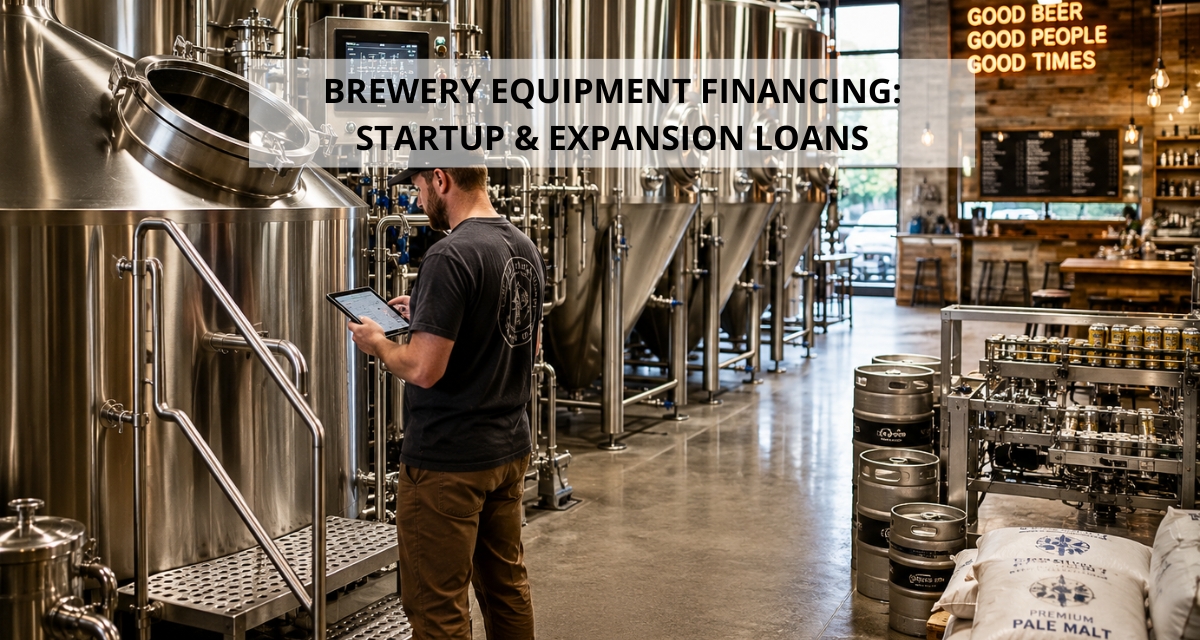
Brewery Equipment Financing: Startup & Expansion Loans
Brewery equipment financing covers the purchase or lease of the physical assets needed to brew, package, and serve beer commercially, including brewing systems, fermentation tanks, kegging and canning lines, refrigeration, and taproom buildout equipment. Lenders evaluate time in business, credit profile, and revenue when structuring a financing arrangement.
For craft breweries looking to open or expand without tying up working capital, Dimension Funding has been financing commercial equipment since 1978, with application-only approvals available up to $250,000 and same-day funding in most cases.
Dimension Funding finances new and used brewery equipment under commercial equipment financing terms that bundle delivery, installation, and related costs into a single fixed monthly payment, with terms extending up to 60 months.
What Brewery Equipment Financing Covers
The financeable list covers the full production chain. Dimension Funding finances brewing kettles, mash tuns, fermentation tanks, brite beer tanks, keg washers, bottling and canning lines, grain handlers, pumps, filters, labeling machines, refrigeration and cooler systems, and taproom furniture and fixtures.
Delivery, setup, and maintenance costs can be included in a single package, helping prevent post-purchase invoices from eroding cash reserves after the deal closes. Brewery management software can also be included, and financing that incorporates software raises the application-only threshold to $500,000.
The Capital Reality of Opening and Growing a Brewery
The U.S. craft brewing industry counted 9,612 active breweries at the end of 2024, according to the Brewers Association, with taproom and brewpub models now representing 73% of all craft businesses. That shift toward hospitality-focused operations means more brewers are equipping not just a production floor but a full customer-facing space at the same time.
The capital requirement reflects that. Brewing systems, fermentation vessels, and a functional taproom represent a significant upfront commitment before a single pint is poured. Financing converts that into a fixed monthly payment, preserving cash for payroll, ingredients, licensing fees, and the working capital buffer every new brewery needs during its first operating year.
The Brewers Association notes that the average craft brewery takes two to three years to reach profitability. Keeping cash on hand through that runway matters more than owning equipment outright from day one.
How Lenders Evaluate a Brewery Application
Credit score, time in business, and annual revenue are the primary factors. Established breweries with two or more years of operating history move through faster and typically access a wider range of terms. Startups carry greater underwriting risk, and most lenders require a business plan, revenue projections, and proof that the required licenses are in place in lieu of operating history.
Dimension Funding accepts most credit profiles, from Tier A down to marginal credit. Applications under $250,000 require no financial statements. Transactions above $250,000 involve a review of basic financials, though the process moves faster than a conventional bank underwriting cycle.
One practical detail: lenders familiar with the brewery space pay attention to the distribution model. A taproom-only brewery carries different revenue predictability than one with established wholesale accounts, and that distinction can affect how an application gets structured.
New Equipment, Used Equipment, Same Program
Dimension Funding finances both new and used brewery equipment under the same terms. For smaller operations and startups, used fermentation vessels and brewing systems are a common path to getting production-ready without the full outlay of new equipment.
Used equipment qualifies for the same fixed monthly payment structure as new. Delivery, installation, and setup costs can be bundled in either case, so there are no separate vendor invoices to manage after the deal closes.
Financing vs. Paying Cash
A brewery that pays cash for its brewing system removes that capital from circulation on day one. The same purchase, financed over 48 months, preserves cash to cover costs that hit immediately after opening: ingredients, staffing, taproom supplies, licensing renewals, and the slower revenue ramp most first-year operations face.
The equipment produces revenue regardless of how it was paid for. The difference lies in how much cash remains available to run the business while revenue builds.
IRS Section 179 adds a practical dimension here. Under 2025 rules, qualifying brewery equipment placed in service before December 31 can be deducted up to $2,500,000 in the year of purchase, per the IRS via Section179.org. Both new and used equipment qualifies. That means a brewery can take the full tax deduction in year one, while the actual cash payments are spread over the financing term. The IRS Section 179 deduction page on Dimension Funding’s site explains how this applies to financed purchases. Talk to a CPA before acting on it.
Applying for Brewery Equipment Financing
Dimension Funding works directly with breweries to finance equipment from their chosen vendor. The application is electronic, execution runs through DocuSign, and funding typically lands within 24 hours of approval. Applications under $250,000 require no financial statements. Transactions above $250,000 require recent tax returns and basic financials.
Use Dimension Funding’s payment calculator to model monthly payment ranges before applying. When ready, the financing application handles requests from first-time startups through established operations expanding capacity or replacing aging equipment. The team is also reachable at 1.800.755.0585.
Frequently Asked Questions
What types of brewery equipment can I finance through Dimension Funding?
Dimension Funding finances virtually any brewery equipment, including brewing kettles, fermentation tanks, brite beer tanks, canning and bottling lines, keg washers, refrigeration systems, grain handlers, and taproom furniture. Delivery, installation, and brewery management software can be included in the same financing package.
How much can a brewery finance without providing financial statements?
Equipment financing up to $250,000 requires no financial statements. If brewery management software is included, the application-only threshold rises to $500,000. Transactions above those amounts require basic financials but still process faster than a traditional bank loan.
What credit score do I need to qualify for brewery equipment financing?
Dimension Funding works with most credit profiles, from strong commercial credit down to marginal ratings. Time in business, revenue, and the overall financial picture are weighed alongside credit score. A lower score does not automatically disqualify an application.
Can a brewery startup qualify for equipment financing?
New breweries can apply. Startups are typically asked for a business plan, revenue projections, and proof that required federal and state licenses are in place in lieu of operating history. Established breweries with two or more years of tax returns on file move through the process faster.
Does brewery equipment financing qualify for an IRS Section 179 deduction?
Financed brewery equipment placed in service during the tax year generally qualifies for Section 179, which allows deductions up to $2,500,000 for 2025 per Section179.org. Both new and used equipment qualify. A brewery can take the full deduction in year one, while cash payments are spread over the financing term. Confirm eligibility with a CPA before filing.
Can I finance used brewery equipment?
Yes. Dimension Funding finances both new and used brewery equipment under the same program terms. Used fermentation vessels, brewing systems, and packaging equipment qualify for the same fixed monthly payment structure as new purchases, with delivery and installation costs included.
How long does it take to get approved and funded?
Most approvals come back the same day. Funding typically follows within 24 hours. The entire process is handled electronically via DocuSign, with no physical paperwork required.