
Excavator financing usually enters the picture at a very specific moment: the operator is hired, the work is lined up, and the only thing between you and the contract is a machine you cannot yet pay cash for.
Most contractors know the workarounds by heart. Rent and watch the margin shrink. Sub out the dirt work and watch the schedule slip. Pass on the job entirely and let a competitor have it. Financing is the fourth option, the one where the machine shows up this week and pays its own way out of the work it does.
This guide explains how excavator loans work across all three size classes, what affects your payment, how new and used machines are financed differently, and where the tax code works in your favor.
If you already have a machine in mind, Dimension Funding finances new and used excavators with application-only approval up to $250,000, so no financial statements are required at that level. You can have an answer before the dealer changes the price.
What Is Excavator Financing?
Excavator financing is a commercial equipment loan or lease used to purchase an excavator, with the machine itself serving as collateral. Because the equipment secures the loan, lenders can approve faster and accept a wider range of credit profiles than they would for an unsecured loan of the same size.
Financing is also the norm rather than the exception. Surveys from the Equipment Leasing and Finance Association consistently find that most U.S. businesses acquire equipment through financing rather than paying cash.
The structure is straightforward. You select the machine, the lender pays the dealer or private seller, and you repay the balance in fixed monthly installments, typically over terms up to 60 months. The excavator goes to work immediately. Your cash stays in the business, covering payroll, fuel, and materials while the machine generates the revenue that covers its own payment.
That last point is the entire logic of equipment financing. An excavator sitting on a job site, billing hourly, is an income-producing asset. Paying for it out of future income it produces is usually smarter than draining the reserves you need to win and run the jobs in the first place. If cash flow is the tighter constraint, a separate working capital loan can cover operating gaps without touching the equipment loan at all.
Mini, Compact, or Full Size: Matching the Loan to the Machine
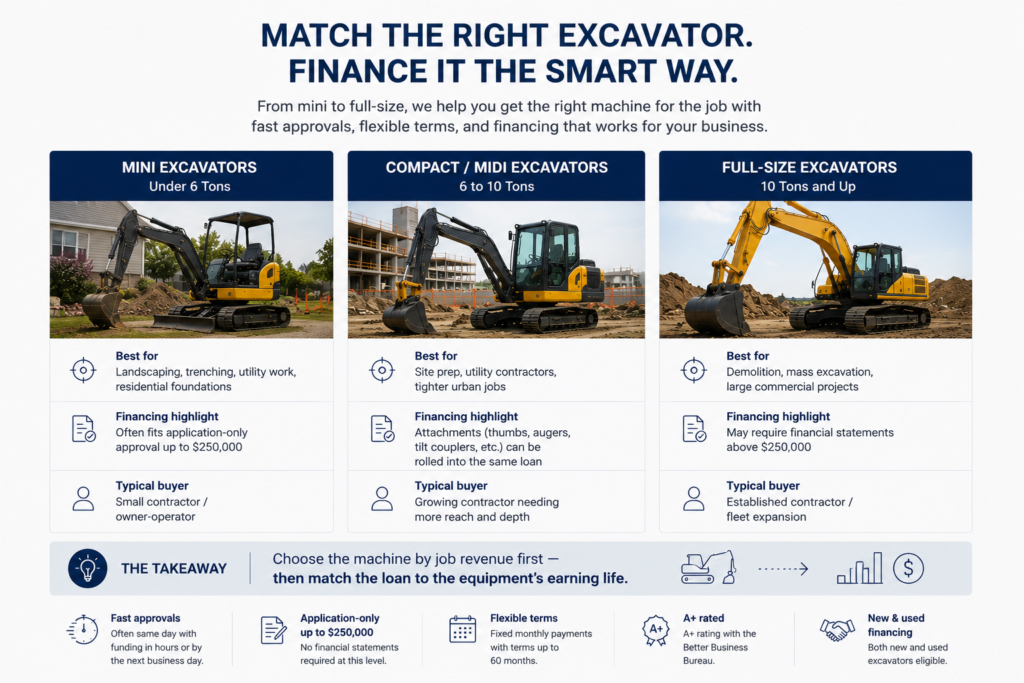
The size class you buy changes the loan amount, but the financing process is nearly identical across all three. What differs is how much of the purchase falls under application-only approval thresholds.
Mini Excavators (Under 6 Tons)
Mini excavators handle trenching, landscaping, utility work, and residential foundations, and most models fall well within application-only territory. For machines in this range, Dimension Funding can approve mini excavator financing without financial statements, often the same day, with funding in hours or by the next business day once documents are signed electronically.
For a small contractor or an owner-operator adding a first machine, this matters. The approval process is a brief electronic application, not a loan committee review. Qualified borrowers may also defer payments for 90 days, with some restrictions, which gives a new machine a full quarter to start earning before the first payment comes due.
Compact and Midi Excavators (6 to 10 Tons)
Midi machines bridge the gap between backyard access and real digging depth. They are popular with site prep crews and utility contractors who need more reach than a mini provides but still work in tight urban lots.
Pricing for these machines varies widely depending on attachments. A hydraulic thumb, an auger drive, or a tilt coupler can add meaningful cost, and a good equipment lender will roll attachments into the same loan rather than forcing a second transaction. Ask before you sign, because financing the bucket separately from the machine is a paperwork problem you do not need.
Full Size Excavators (10 Tons and Up)
Full-size excavators are the heavy hitters of construction equipment financing, and their price tags often exceed application-only limits. Above $250,000, expect to provide financial statements, which is standard across the industry for transactions of that size.
The good news is that larger deals get more structural flexibility. Dimension Funding provides business financing of up to $10 million, so a fleet purchase or a full-size machine with a long-reach boom and multiple attachments can be financed at a single facility. Contractors expanding into demolition or mass excavation frequently pair an excavator loan with dump truck financing to build out the full production loop at once.
New vs. Used Excavator Loans
Lenders finance both, but the math differs in ways worth understanding before you shop.
New machines carry full warranties and the latest emissions and telematics packages, and they typically qualify for the longest terms because their useful life extends furthest beyond the loan term. Used machines cost less up front, and a well-maintained excavator with documented hours holds value remarkably well, which is exactly why lenders are comfortable taking one as collateral.
The variable to watch on used equipment is the seller. Dealer sales with inspection records move through underwriting quickly. Private party sales can still be financed, but expect the lender to verify the machine’s condition and clear title. Dimension Funding finances both new and used excavators, so the decision can rest on jobsite economics rather than on what a lender will allow.
One practical rule: match the loan term to the machine’s remaining working life. Financing a 9,000-hour excavator over 60 months invites a situation where you are making payments on a machine that has stopped earning. A shorter term costs more per month and saves you from that trap.
What Shapes Your Monthly Payment
Four inputs determine what you will pay each month.
Loan amount and down payment. The financed balance drives everything. Some programs require a down payment, while strong applicants may qualify for full financing of the purchase price.
Term length. Terms up to 60 months are available. Longer terms lower the monthly payment, while shorter terms pay the machine off sooner and free up borrowing capacity for your next purchase.
Credit profile. Lenders weigh credit history when structuring a deal. Dimension Funding works with most types of borrower credit, so a past rough patch shapes the structure rather than automatically triggering a decline.
Structure: loan vs. lease. A loan builds equity toward ownership. An equipment lease can lower monthly costs and simplify upgrades when technology or emissions standards change. The right answer depends on how long you plan to run the machine.
Before talking to any lender, decide what monthly payment your job calendar can support, and test how the term length and loan amount affect that number. Walking into a financing conversation with a target payment in mind puts you in control of the negotiation.
Section 179 and the Tax Side of an Excavator Purchase
A financed excavator can generate a tax deduction far larger than the payments you make in year one. Under IRS Section 179, qualifying businesses can deduct the full purchase price of equipment placed in service during the tax year, even when the purchase is financed.
Read that again, because it surprises many first-time buyers. You can finance the machine, make a handful of monthly payments before December 31, and still deduct the entire purchase price for that tax year, subject to annual IRS limits. Dimension Funding maintains a current breakdown of limits and qualifying rules on its Section 179 deduction page.
Timing matters here. The machine must be placed in service, not merely ordered, before year-end. Contractors planning a Q4 purchase should factor in delivery lead times when making the decision and confirm specifics with their tax professional, since eligibility depends on your business’s income and total equipment spend.
Why Contractors Finance Excavators Through Dimension Funding
Dimension Funding has provided equipment financing to small and medium-sized businesses across the U.S. since 1978. That tenure shows up in the details that matter on a deal: an electronic application signed through DocuSign, approvals that often come back the same day, and funding that typically lands within hours or by the next business day.
The numbers that define the program are simple. Application-only equipment financing up to $250,000 with no financial statements. Total financing capacity above $10 million for larger purchases. Fixed monthly payments with terms up to 60 months. Most credit types considered. New and used machines both eligible. An A+ rating from the Better Business Bureau backs all of it.
If you are pricing a mini excavator for utility work or a 30-ton machine for mass excavation, start a financing application or call 800.755.0585. You can also run the numbers yourself first with the payment calculator. Either way, a quick, no-obligation quote will tell you exactly what the machine costs per month before you commit to anything.
Frequently Asked Questions
How hard is it to get financing for an excavator?
Excavator financing is among the more accessible forms of business credit because the machine itself secures the loan. Lenders like Dimension Funding consider most types of borrower credit, and equipment purchases up to $250,000 can be approved on an application alone, without financial statements.
Can I finance a used excavator?
Yes, used excavators qualify for financing, including machines purchased from dealers and, in many cases, private sellers. Lenders will weigh the machine’s age, hours, and condition when setting terms, so documented maintenance records strengthen your application and help underwriting move faster.
How long can I finance an excavator for?
Dimension Funding offers excavator financing terms up to 60 months with fixed monthly payments. The right term depends on the machine’s age and remaining working life, since the loan should not outlast the equipment’s earning years.
Can I deduct a financed excavator on my taxes?
Yes, financed equipment can qualify for the Section 179 deduction in the year it is placed in service, even though you have not paid for it in full. That means a machine financed in November can potentially generate a full purchase price deduction for that tax year. Confirm eligibility and current limits with your tax advisor.
Do excavator attachments count toward the loan?
Attachments such as buckets, thumbs, augers, and couplers can typically be rolled into the same financing as the machine. Bundling them keeps you on one payment and one approval rather than splitting the purchase across multiple transactions.
Can equipment dealers offer their customers financing through Dimension Funding?
Yes, Dimension Funding runs a vendor financing program that lets excavator dealers and equipment sellers offer financing directly to their buyers. Presenting a monthly payment next to the sticker price helps dealers overcome payment objections, shorten the sales cycle, and close larger transactions.