
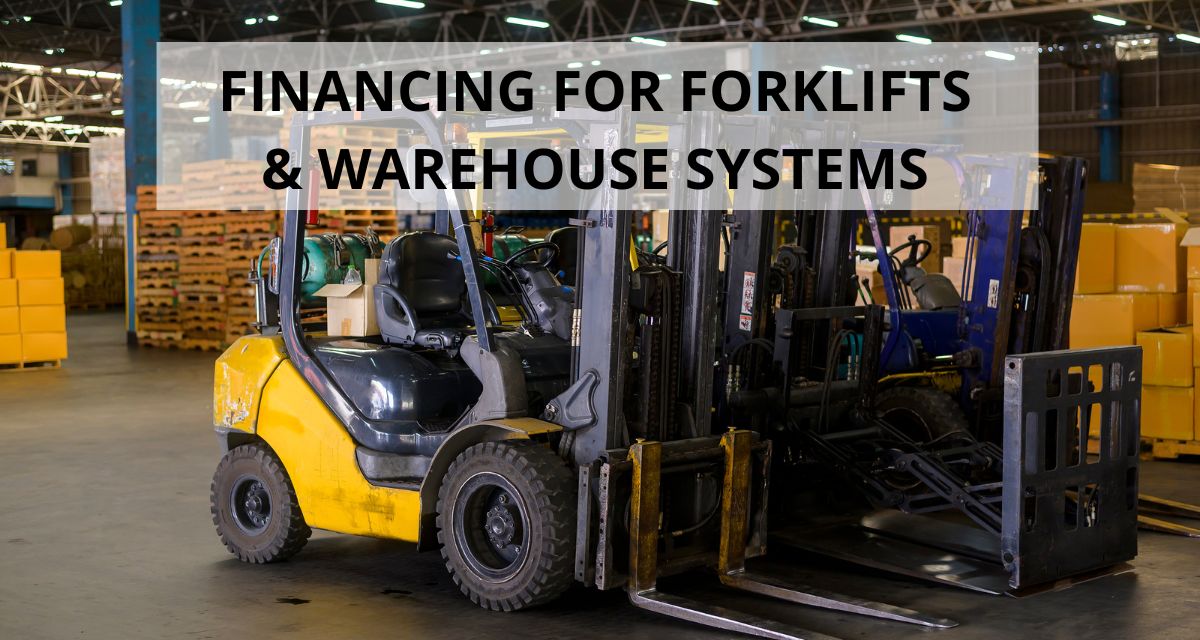
Material Handling Equipment Financing: Forklifts & Warehouse Systems
Warehouses don’t make money standing still. When throughput slows because equipment is aging, undersized, or simply absent, the cost shows up immediately in labor hours, fulfillment delays, and contract risk. Dimension Funding has been structuring financing for warehouse and logistics operations for over 40 years, covering everything from a single replacement forklift to full-scale automation buildouts across the United States.
This guide is written specifically for warehouse operators, 3PL companies, e-commerce fulfillment centers, and logistics businesses evaluating equipment and automation financing in 2026.
What Material Handling Equipment Can Be Financed?
The full scope of what a modern warehouse or distribution center requires is financeable through Dimension Funding: lift trucks, reach trucks, order pickers, pallet jacks, side loaders, platform trucks, cranes, hoists, conveyors, sortation systems, automated storage and retrieval systems (AS/RS), warehouse management system (WMS) software, racking and shelving infrastructure, and packaging and processing equipment.
Both new and used units qualify. All associated project costs, including delivery, installation, systems integration, and maintenance agreements, can be bundled into the financing so your monthly payment reflects the actual cost of putting the equipment to work, not just the sticker price.
Financing Forklifts: Fleet, Used, and Specialty Units
Forklifts sit at the center of most material handling financing conversations, and the considerations are more nuanced than they appear.
Fleet purchases can be consolidated under a single financing agreement, which eliminates the administrative burden of managing multiple contracts and simplifies budgeting across a facility. This matters particularly for 3PL operators and large fulfillment centers that need to equip multiple docks or shift configurations simultaneously.
Propane vs. Electric: A Financing Consideration
Propane vs. electric is a genuine financing consideration, not just an operational one. Electric forklifts carry a higher upfront cost but lower operating expenses over time. Some financing structures allow the energy savings to offset a portion of the monthly payment math, making the total cost of ownership calculation more favorable than the sticker price suggests. Propane units typically finance at lower dollar amounts and shorter terms.
Used and Refurbished Forklifts
Used and refurbished forklifts are fully eligible and represent one of the better financing opportunities in the material handling category. The secondary market for counterbalance and reach trucks is active and well-documented, which supports strong residual values and gives lenders confidence in the collateral.
Warehouse Automation and Integrated Systems
According to the Equipment Leasing & Finance Foundation, material handling has remained one of the strongest and most active segments of the equipment finance market, with lender appetite for warehouse and automation deals holding steady through 2025 and into 2026.
Automation investment in U.S. warehouses has accelerated significantly, driven by e-commerce growth, labor cost pressures, and the operational requirements of same-day and next-day fulfillment expectations. Projects that once involved buying a few forklifts now routinely include conveyor networks, AS/RS installations, autonomous mobile robots (AMRs), goods-to-person systems, and the WMS software that coordinates all of it.
Financing a Multi-Component Automation Project
These projects present a specific financing challenge: the total cost spans physical equipment, software, third-party implementation vendors, and infrastructure modifications, often contracted across multiple invoices.
Dimension Funding can finance all of it under a single agreement, consolidating hardware, software, installation, and vendor costs into one fixed monthly payment. For a warehouse operator managing a $400,000 automation upgrade, the difference between financing it as a unified project versus piecing together multiple credit facilities is meaningful both administratively and financially.
Lease vs. Finance Agreement: The Material Handling Calculus
The technology obsolescence question is more pressing in material handling than in almost any other equipment category. A racking system installed today will likely still be useful in fifteen years. A goods-to-person robotics system may look significantly different by the time a seven-year term ends.
That asymmetry shapes the lease vs. buy decision. For long-lived infrastructure — including racking, shelving, cranes, and conveyors — a finance agreement is usually the right structure. These assets depreciate slowly, hold collateral value well, and are worth owning. For technology-driven automation equipment, an operating lease offers the flexibility to upgrade when the technology moves. For forklift fleets, the calculus depends on utilization intensity and replacement cycle.
Dimension Funding offers both equipment lease financing and finance agreements.
Terms for Material Handling Equipment in 2026
Material handling equipment financing through Dimension Funding is available with terms up to 60 months for most equipment, with larger automation and warehouse system projects potentially eligible for extended terms based on the scope and asset composition of the deal.
Automation projects that include software and integration work are underwritten somewhat differently than a straightforward forklift purchase, and understanding that distinction before you apply helps set accurate expectations.
Seasonal Payment Structures
Warehouse and fulfillment businesses frequently carry uneven revenue across the calendar year. Q4 volume for an e-commerce operator can dwarf the rest of the year, while agricultural logistics businesses may see the inverse.
Dimension Funding’s working capital products offer daily, weekly, or monthly repayment options, which can be structured around your actual revenue cycle rather than a fixed calendar schedule. This is worth knowing when you’re modeling financing costs against a seasonal cash flow curve.
Equipment Financing vs. Working Capital for Warehouse Purchases
Working capital loans are designed for operational expenses, short-term cash needs, and bridge financing. They are not optimally structured for acquiring warehouse assets.
Equipment financing is secured by the asset itself, which produces longer repayment terms than unsecured working capital lending. Dimension Funding’s working capital loans run from $25,000 to $250,000 with terms up to 24 months. A $300,000 conveyor installation financed as working capital would carry substantially higher monthly payments and total cost than the same project financed as equipment. For any material asset acquisition, equipment financing is the more appropriate and cost-effective instrument.
Qualifying for Material Handling Financing
Warehouse and logistics businesses span a wide range of credit profiles and operating histories, and qualification requirements reflect that range. For newer or smaller operations, application-only financing covers most standard transactions without requiring financial statements. Larger multi-system projects have higher documentation thresholds, though the process through Dimension Funding remains faster and less burdensome than conventional bank lending, which typically requires a blanket lien on all business assets rather than the equipment-specific collateral structure that private lenders use.
Rapidly scaling 3PL operators and e-commerce fulfillment businesses sometimes assume their growth trajectory works against them in a financing application. In practice, strong revenue trends and a clear equipment-to-revenue connection can support approval even when the business history is shorter than ideal.
Get Your Warehouse Operating at Full Capacity
Whether you’re replacing a single aging forklift or financing a full automation overhaul, the structure of the deal has real consequences for your cash flow and operational flexibility. The team at Dimension Funding has spent over four decades working through exactly these decisions with warehouse and logistics businesses of every size.
Reach out to the team to work through your options, learn more about Dimension Funding, or submit a financing application when you’re ready to move forward.
Frequently Asked Questions
Can I finance both new and used forklifts?
Yes. Dimension Funding finances new, used, and refurbished forklifts across all types, including electric, propane, and high-capacity specialty units. The active secondary market for lift trucks supports strong collateral values on used equipment.
Can I finance an entire warehouse automation project under one agreement?
Yes. Dimension Funding bundles all project costs, including racking, conveyors, robotics, WMS software, installation, and third-party vendor fees, into a single financing agreement with one fixed monthly payment.
Is leasing or buying better for forklifts?
It depends on your replacement cycle and utilization intensity. High-hour operations that replace equipment every three to five years often find leasing more cost-effective. Facilities where forklifts remain in service for ten or more years typically benefit from ownership through a finance agreement. Dimension Funding offers both.
How do I choose between a lease and a finance agreement for automation equipment?
Technology-driven automation systems evolve quickly, which makes the upgrade flexibility of a lease worth considering. For infrastructure assets like racking, cranes, and conveyors that hold value and remain useful for many years, a finance agreement builds equity in assets worth owning long-term.
What is the difference between equipment financing and a working capital loan for warehouse purchases?
Equipment financing is secured by the asset and carries longer terms than unsecured working capital lending. Working capital loans from Dimension Funding run up to $250,000 with terms up to 24 months, making them appropriate for operational expenses rather than large asset acquisitions.
How fast can I get approved and funded?
Approvals typically come through within hours of submitting an application, with funding following within 48 hours. Same-day funding is often available. The process runs entirely through DocuSign.
Can a fast-growing fulfillment business or newer 3PL qualify?
Yes. Strong revenue trends and a clear connection between the equipment and revenue generation can support approval even with a shorter operating history. Dimension Funding evaluates the full picture rather than applying rigid cutoffs.
If you want to upgrade your tasting room or winery equipment, financing from Dimension can help. Turn a large, upfront cost into monthly payments over the lifetime of the equipment. Financing winery equipment can expand your business while maintaining your cash flow.